Understanding Industry Applications: Thermal vs. Atomization Demands in Southeast Asia
Southeast Asian industrial facilities operate under distinct environmental and operational pressures. High ambient temperatures, humidity variations, and demand for compact footprint solutions require equipment that can manage both combustion processes and precise fluid handling simultaneously. The choice between thermal management systems and atomization equipment isn't binary—modern maintenance operations demand integration of both technologies.
With 35+ years of industrial equipment distribution experience, 3G Electric has observed that the most effective maintenance strategies pair complementary systems: burners that regulate heat output with nozzles that ensure uniform fuel distribution, supported by temperature monitoring that prevents operational drift. This article guides maintenance teams through selecting the right combination for your facility's specific Industry Applications.
Section 1: Burner Systems vs. Nozzle-Centric Atomization
Full Combustion Assembly: When to Choose Integrated Burner Systems
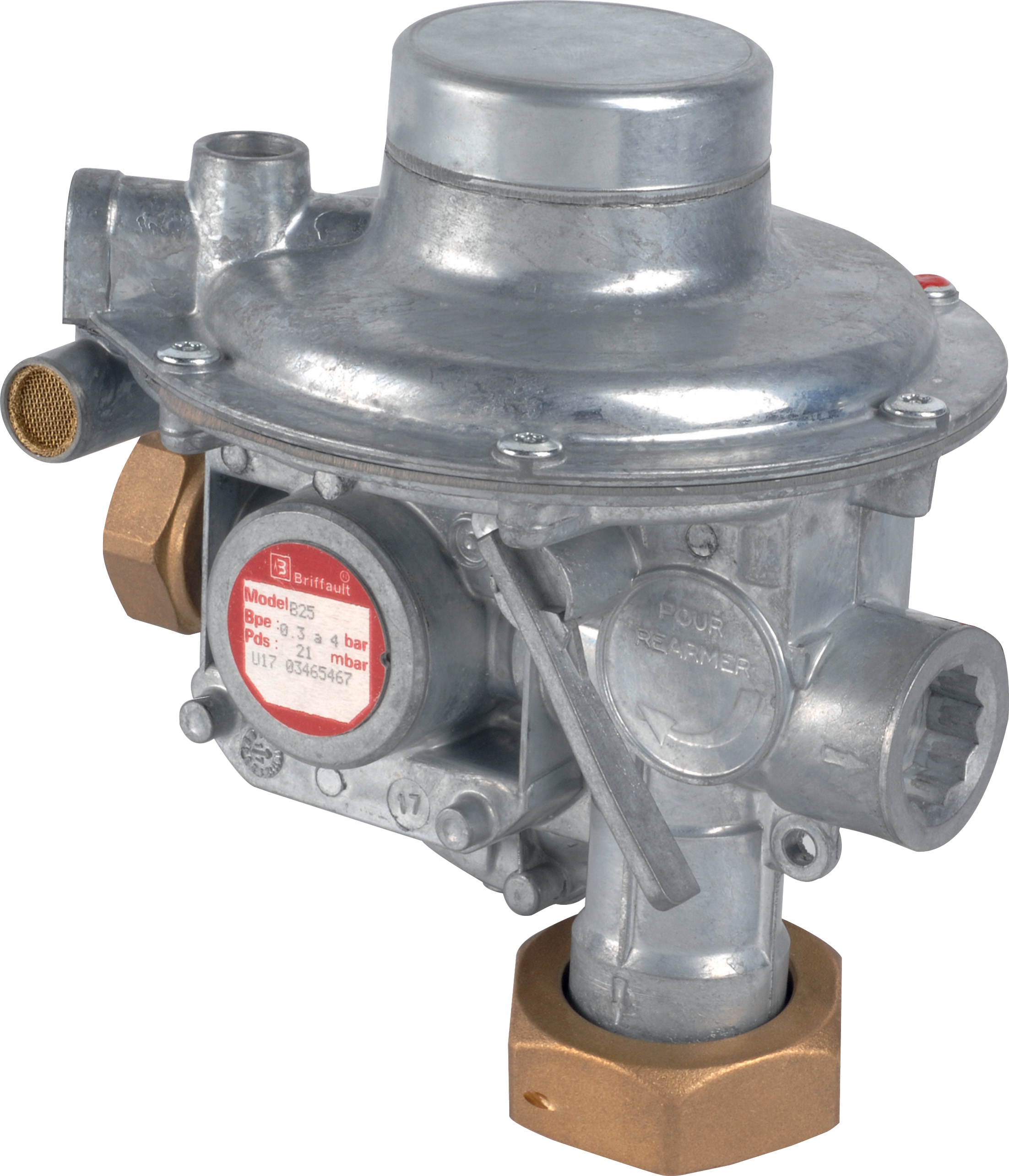
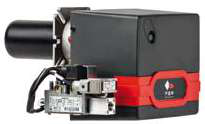
The FBR X GAS X0 CE TC + RAMPA CE D1/2"-S (Methane) represents a complete combustion solution delivering 11.6 kW to 34.3 kW with integrated gas train regulation. This burner system is engineered for modulating combustion—meaning it adjusts heat output based on facility demand, not just on/off operation.
When to specify integrated burner assemblies:
- Facilities requiring variable heat output (textile drying, food processing, chemical heating)
- Operations where gas supply regulation must be localized at the burner point
- Systems with space constraints preventing separate regulation components
- Southeast Asian installations where local service networks favor complete assemblies over component sourcing
The FBR X GAS system's modulating capability makes it ideal for maintenance teams managing fluctuating production schedules. Rather than oversizing a fixed-output burner, modulation reduces energy waste during partial-load operation—critical in high-energy-cost Southeast Asian markets.
Standalone Nozzle Selection: Precision in Specific Applications
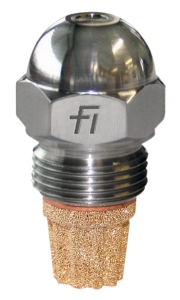
When combustion control is secondary and fluid atomization precision is primary, standalone nozzle selection offers flexibility. The Jetoil 3.50 80° S delivers flow rates from 0.40 to 35.00 GPH with an 80° spray angle, handling everything from light machine lubrication to heavy-duty fuel atomization.
Complementary option: The CBM Fluidics 0.50 60° SF provides tighter atomization (1.4 L/h at 10 bar) with a 60° cone angle, ideal for applications requiring uniform coverage over smaller surface areas.
When to select standalone nozzles:
- Burner systems already equipped with factory-matched nozzles (avoiding over-specification)
- Retrofit projects where combustion control exists but spray pattern needs adjustment
- Lubrication systems, spray coating, or cooling applications separate from primary combustion
- Maintenance teams with established nozzle inventory requiring compatible replacement parts
A textile finishing facility in Thailand initially used a fixed-output burner with a Jetoil 3.50 80° nozzle for dryer control. During monsoon seasons, relative humidity surged, causing over-drying and product damage. By retrofitting with the modulating FBR X GAS system and adjusting to the higher-angle Jetoil nozzle, the facility achieved responsive heat control and improved product consistency.
Section 2: Flow Rate Performance Across Southeast Asian Operating Conditions
Jetoil 3.50: High-Capacity General Purpose
The Jetoil 3.50 80° S operates across 0.40 to 35.00 GPH, covering applications from precision metering to high-volume spray cooling. The 80° spray angle creates a wide, shallow cone—optimal for distributed coverage over broad surfaces.
Southeast Asia-specific advantages:
- Wide flow range accommodates seasonal demand fluctuations without component changes
- 80° angle minimizes bounce-back on tropical humidity-prone surfaces
- Proven performance in high-temperature environments (common in Southeast Asian industrial zones)
CBM Fluidics 0.50: Precision Atomization
At 1.4 L/h (0.37 GPH) fixed output with a 60° cone, the CBM Fluidics 0.50 prioritizes spray uniformity over flow flexibility. This is 95× smaller in output than the Jetoil's maximum, reflecting a fundamentally different application class.
When CBM Fluidics 0.50 is essential:
- Precise dosing applications (additive injection, catalyst distribution)
- Burner pilot lights or auxiliary fuel lines
- Small-capacity lubrication systems on CNC machines
- Applications where over-spray wastes expensive fluids
A Malaysian food processing plant needed to choose between nozzles for a cooking oil misting system. Daily volumes ranged 5–15 GPH depending on batch size. The Jetoil 3.50 was specified because its range (0.40–35.00 GPH) covered all production scenarios with a single component type, simplifying maintenance inventory and reducing part changeover time.
Section 3: Temperature Monitoring as Critical Infrastructure
Neitherburner systems nor nozzles function optimally without temperature feedback. The Fantini Cosmi LS150 Thermocouple J Probe extends temperature measurement from 0 to 450°C with ±2.5°C precision, featuring AISI 316 stainless steel construction rated IP65—essential for Southeast Asia's corrosive industrial environments.
Why Temperature Monitoring Belongs in Industry Applications Planning
Maintenance teams often treat temperature probes as afterthoughts, but they are foundational to system tuning:
- Burner commissioning: The FBR X GAS modulating system requires accurate temperature feedback to optimize combustion efficiency. Without verified probe data, technicians cannot confirm the burner is reaching target output.
- Nozzle performance validation: When switching between Jetoil and CBM Fluidics nozzles, temperature profiles change. A probe confirms whether the new nozzle is delivering equivalent heat transfer.
- Predictive maintenance: Tracking temperature drift over weeks signals nozzle wear or combustion degradation before catastrophic failure.
- Humidity compensation: Southeast Asia's high humidity affects fuel viscosity and combustion. The LS150's ±2.5°C accuracy enables fine-tuned adjustments.
- AISI 316 stainless steel resists salt-air corrosion common in coastal Southeast Asian facilities
- IP65 protection prevents moisture ingress in high-humidity industrial spaces
- Thermocouple J type handles wide temperature ranges without recalibration
- Modular design allows probe replacement without system shutdown
Section 4: System Integration Strategy for Maintenance Teams
Matching Equipment to Facility Class
Tier 1 (Continuous high-output operations):
Specify the FBR X GAS X0 CE TC with Jetoil 3.50 nozzle and continuous temperature monitoring via Fantini Cosmi LS150. This combination handles 24/7 operations common in Southeast Asian textile mills, plastic extrusion, and chemical processing.
Tier 2 (Batch/intermittent operations):
Implement FBR X GAS modulation with CBM Fluidics 0.50 for auxiliary lines, plus spot temperature checks. This reduces idling losses during downtime—significant cost savings in energy-intensive regions.
Tier 3 (Retrofit/upgrade):
For existing facilities with fixed-output burners, prioritize Jetoil 3.50 nozzle upgrade (improves spray uniformity) plus Fantini Cosmi temperature monitoring (enables performance baseline). Full burner replacement deferred until capital cycle permits.
Maintenance Best Practices with Integrated Systems
Quarterly procedures:
- Inspect nozzle spray pattern using test spray into container; compare volume and cone angle to baseline data
- Record temperature readings at steady state; document any drift >5°C from commissioning values
- Check burner gas train for leaks using soapy water on all joints
- Replace nozzle (whether Jetoil or CBM Fluidics) as preventive measure; worn nozzles cause 10–15% efficiency loss
- Recalibrate Fantini Cosmi LS150 against reference thermocouple if drift exceeds ±5°C
- Audit fuel consumption against historical baseline; >10% increase signals combustion degradation
Southeast Asia-Specific Integration Notes
Salt-air environments (coastal facilities):
Prioritize AISI 316 stainless steel components (Fantini Cosmi LS150) and schedule nozzle cleaning every 4 weeks instead of quarterly, as salt deposits accelerate wear.
High-humidity zones (monsoon regions):
Install temperature probes in climate-controlled enclosures when feasible; use sealed cable glands on all electrical connections. The Fantini Cosmi IP65 rating is necessary but not sufficient—additional environmental protection extends probe lifespan from 2–3 years to 5+ years.
Energy-cost-sensitive markets (Philippines, Vietnam, Thailand):
Invest in modulating burner systems like FBR X GAS even if upfront cost is 20–30% higher than fixed-output alternatives. ROI typically occurs within 18–24 months through reduced fuel consumption during partial-load operation.
Procurement and Sourcing Strategy
3G Electric's 35+ years of industrial distribution experience in Southeast Asia provides immediate advantages: local inventory of all referenced components, established relationships with field service networks, and understanding of regional voltage standards and certification requirements.
When sourcing the FBR X GAS, Jetoil/CBM Fluidics nozzles, and Fantini Cosmi probes through 3G Electric:
- Confirm voltage specifications match facility electrical standards (critical in Thailand and Vietnam where variation occurs)
- Verify CE/local certification status for each component
- Establish spare parts agreement for nozzles and probes (highest-wear consumables)
- Request field commissioning support to validate modulation performance before full production load
Maintenance teams reduce downtime risk by consolidating multiple component purchases through a distributor familiar with system integration requirements, rather than sourcing burners, nozzles, and probes independently.
Conclusion
Industry Applications equipment selection in Southeast Asia demands balancing thermal management (burner systems), precision atomization (nozzles), and measurement accuracy (temperature probes). The FBR X GAS X0 CE TC provides modulating combustion control, the Jetoil 3.50 and CBM Fluidics 0.50 offer complementary atomization across flow ranges, and the Fantini Cosmi LS150 enables data-driven tuning and predictive maintenance.
Maintenance teams that integrate all three component classes—rather than treating them as separate purchases—achieve higher operational efficiency, lower energy costs, and predictable maintenance cycles. Regional factors like humidity, salt exposure, and energy pricing make this integrated approach particularly valuable in Southeast Asian facilities.