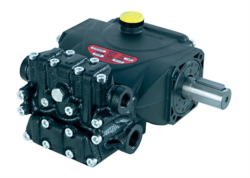
Understanding Pumps & Compressors Core Specifications
Pumps and compressors are fundamental to industrial operations, yet many plant managers struggle with translating manufacturer specifications into operational decisions. With over 35 years of experience as a global industrial equipment distributor, 3G Electric has observed that specification misalignment is a leading cause of equipment underperformance and premature failure.
The three critical parameters you must master are flow rate (L/min or GPM), pressure (bar or PSI), and power consumption (kW or hp). These parameters are not independent—they form a relationship where power = (pressure × flow) ÷ 600 for metric units. Understanding this relationship allows you to validate manufacturer claims and identify equipment suited to your actual operational demands.
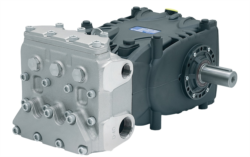
For example, the Pratissoli KF30 delivers 106 L/min at 200 bar using 40 kW of input power. This specification tells you it handles moderate to high-pressure applications with consistent flow delivery. When you multiply 200 bar × 106 L/min ÷ 600, you get approximately 35.3 kW theoretical requirement, meaning the 40 kW motor provides an appropriate safety margin for real-world inefficiencies (typically 10-15% losses in hydraulic systems).
When selecting equipment for your facility, verify three conditions: (1) Does the pump or compressor produce the minimum flow your process requires? (2) Does it maintain that flow at the pressure your system demands? (3) Is the motor size adequate without operating at continuous maximum load? Undersized equipment runs hot and fails early; oversized equipment wastes energy and reduces part-life efficiency.
Pressure-Flow Matching for Process Integration
One of the most common deployment errors occurs when plant managers treat pump selection as a standalone decision rather than a system integration task. Your process doesn't care about the pump specification—it cares about receiving the right combination of flow and pressure at the point of use.
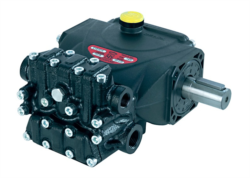
Consider a scenario where your production line requires 150 bar pressure and 120 L/min flow. The Pratissoli SS71153 delivers exactly 122 L/min at 160 bar (a 10 bar safety margin above minimum), operating at 800 rpm with 37.5 kW input. This specification makes it suitable for your process. However, if you selected a compact unit like the Interpump E1D1808 L—which only delivers 8 L/min at 180 bar—you would face severe undersizing and process slowdown.
The deployment principle is straightforward: match the pump's minimum flow to your maximum continuous demand, and ensure rated pressure exceeds your system pressure by 10-15%. This approach prevents cavitation (flow starvation), allows for pressure relief settings, and accommodates future system modifications.
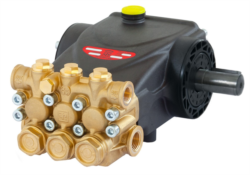
For high-pressure applications under 10 L/min, compact gear pumps like the Interpump ET1C1612 SX*D20 (12 L/min at 160 bar) offer space efficiency in confined installations. The PTFE construction resists chemical degradation, making it suitable for food processing, pharmaceutical, or chemical handling environments where standard materials might corrode.
Medium-flow applications (80-220 L/min) are where most manufacturing operations operate. The Pratissoli MW40 (211 L/min at 210 bar, 85 kW) serves this range effectively. Its larger displacement allows operation at lower RPM, reducing wear and noise—critical factors when equipment operates continuously in multi-shift facilities.
Power Consumption and Operating Cost Reality
Plant managers are increasingly held accountable for operational cost control. Pump and compressor selection directly impacts your facility's energy spend. A 40 kW pump running 16 hours daily costs approximately $92 per day in electricity (at $0.12/kWh industrial rates), or $33,580 annually. An 85 kW unit operating the same schedule costs $74,480 annually. This 123% cost difference justifies careful specification analysis.
However, the temptation to select undersized "efficient" equipment is dangerous. An undersized pump operating at maximum load and pressure generates excess heat, reducing efficiency to 70-75%. That same pump sized appropriately for your demand operates at 85-90% efficiency. In this scenario, paying for extra capacity actually reduces your lifetime energy costs because the equipment doesn't strain continuously.
3G Electric's experience across global manufacturing facilities reveals that optimal total cost of ownership occurs when equipment operates between 60-85% of rated capacity. Below 60%, you're paying for unused capability. Above 85%, efficiency drops, maintenance accelerates, and failure risk increases.
For facilities with variable demand, hybrid approaches work well. Use smaller high-pressure units (like the E1D1808 L) for peak demand periods, and pair them with larger, lower-RPM units for base load operation. This strategy reduces energy consumption during light production cycles and maintains efficiency across varying workloads.
Material Selection and Environmental Integration
Beyond flow, pressure, and power, material composition determines how long your equipment survives in your specific environment. Industrial facilities vary dramatically—some expose pumps to corrosive chemicals, others to extreme temperature swings, and others to contaminated fluid streams.
The Interpump ET1C1612 with PTFE construction demonstrates this principle. PTFE (polytetrafluoroethylene) seals resist chemical attack and handle temperature ranges from -40°C to +200°C. This material choice makes sense for chemical processing or industrial cleaning operations where standard elastomer seals would degrade within months.
For standard hydraulic applications in machine shops, manufacturing plants, and assembly facilities, cast iron and aluminum bodies with nitrile seals (standard on the KF30 and MW40) provide excellent value. These materials resist normal hydraulic fluid exposure and tolerate ambient temperatures from -10°C to +60°C—typical for climate-controlled manufacturing environments.
When deploying equipment in outdoor installations, coastal areas, or facilities with high-humidity conditions, corrosion protection becomes critical. Specify stainless steel fasteners and painted or coated bodies. Temperature also matters—equipment rated for 50°C ambient shouldn't operate in a facility where summer temperatures reach 55°C sustained, as the hydraulic fluid itself will exceed its recommended operating range.
Before finalizing any specification, conduct an environmental audit of your deployment location: What's the maximum ambient temperature? What fluids will contact the pump (hydraulic oil, water, detergent, chemicals)? Will the equipment sit idle seasonally? What's your maintenance interval capacity? These answers guide material selection.
Deployment Checklist and Commissioning Protocol
Once you've selected appropriate equipment, deployment success depends on proper installation and initial commissioning. 3G Electric recommends the following protocol:
Pre-Installation Phase:
- Verify motor supply voltage matches equipment nameplate (three-phase 380V, 400V, or 480V; single-phase alternatives available)
- Confirm coupling or belt drive can safely transmit rated torque
- Inspect all fluid lines for cleanliness—dirt in hydraulic systems causes immediate pump failure
- Test fluid compatibility; incompatible oils damage seals within hours
- Prime the pump before first operation; running dry for even 30 seconds damages internal components
- Start with low load; allow 10-15 minutes for hydraulic fluid to reach operating temperature (typically 35-45°C)
- Monitor discharge pressure with a calibrated gauge; it should remain stable, not spike or oscillate
- Listen for cavitation noise (a grinding or crackling sound), which indicates inlet starvation
- Check temperature every 4 operating hours; continuous operation shouldn't exceed 65°C
- Monitor pressure relief settings; they should limit system pressure to 10% above your process maximum
- Inspect all connections for leaks; external leaks waste energy and create safety hazards
- Measure actual flow output against specification to confirm proper operation
- Change hydraulic fluid at manufacturer-recommended intervals (typically 2,000 operating hours for industrial duty)
- Replace inlet filters every 500-1,000 operating hours depending on ambient contamination
- Inspect seals and bearings at each fluid change
- Track operating hours, temperature, and pressure; sudden changes indicate developing problems
With over 35 years' experience supporting global industrial operations, 3G Electric has observed that facilities following this checklist experience 40% fewer equipment failures and achieve 30-50% longer pump life compared to operations that skip commissioning rigor.
Connecting Specification to Operational Strategy
Ultimately, selecting and deploying pumps and compressors is a strategic decision that affects production capacity, energy costs, equipment reliability, and maintenance burden. Plant managers who master specification alignment report three consistent benefits: reduced unplanned downtime, lower total cost of ownership, and improved production consistency.
The KF30, MW40, and specialized units like the E1D1808 L and ET1C1612 represent different points on the efficiency-capacity spectrum. Your job is matching that spectrum to your facility's actual operational profile, not to marketing claims or budget convenience.
When you have questions about whether a specific unit suits your application, 3G Electric's technical team can evaluate your flow requirements, pressure specifications, environment, and duty cycle. As a global distributor with decades of deployment experience, we've solved these matching problems across industries and regions. Your success depends on getting this decision right at the specification stage—before equipment arrives and installation begins.