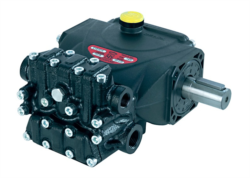
Introduction: Why Redundancy Matters for Your Plant Operations
Pumps & Compressors are the circulatory system of industrial plants. Whether supplying high-pressure hydraulic fluid for metal stamping, pneumatic power for assembly lines, or coolant circulation for precision machining, a single pump or compressor failure can cascade into facility-wide shutdowns. Plant managers across Europe, Asia, and North America increasingly recognize that the cost of redundancy—purchasing and installing backup equipment—is far lower than the cost of unplanned downtime.
With 35+ years of experience as a global industrial equipment distributor, 3G Electric has supported plant managers through countless failure scenarios. The lesson is consistent: facilities that invest in planned redundancy recover faster, maintain better productivity metrics, and avoid the exponential costs of emergency overtime, expedited repairs, and lost customer commitments.
This guide addresses the specific technical and operational decisions you need to make when designing redundant Pumps & Compressors systems. We'll cover architecture options, specification matching, switchover protocols, and equipment selection using real industrial examples.
Section 1: Redundancy Architecture—Choosing the Right Strategy for Your Process
Active-Active Configuration: Continuous Load Sharing
In an active-active system, two or more pumps or compressors operate simultaneously, each carrying a portion of the total flow or pressure demand. If one unit fails, the remaining equipment continues delivering partial output—often sufficient to maintain critical processes at reduced capacity until repairs are completed.
Best for:
- High-volume cooling or circulation systems where temporary flow reduction is tolerable
- Large manufacturing facilities with multiple production lines
- Processes where gradual degradation is preferable to sudden loss
Technical considerations:
- Flow dividers or load-sharing logic required
- Pump displacement must be identical to prevent backpressure issues
- Both units wear at similar rates—stagger maintenance schedules
- Requires reliable check-valve configuration to prevent reverse flow
Active-Standby Configuration: Automatic Switchover
One primary pump or compressor runs continuously while an identical backup unit remains idle but ready. Upon primary failure, an automated system (pressure switch, flow sensor, or operator command) shifts the load to the standby unit. This approach guarantees full output capacity after switchover.
Best for:
- Critical single-point loads (e.g., emergency cooling, safety systems)
- Processes requiring constant full-capacity output
- Facilities where partial capacity is not operationally acceptable
Technical considerations:
- Requires dual-solenoid check-valve manifold or automated ball-valve switchover
- Standby unit must be identical in displacement and pressure rating
- Weekly or monthly no-load runtime recommended to keep seals lubricated
- Manual override critical for maintenance scenarios
Graduated Redundancy: Multiple Units with Stepped Capacity
For large facilities, deploy three or more units sized to handle specific load scenarios. For example, one full-capacity primary unit plus two smaller units that activate only if primary fails.
Example: A large-volume cooling system could use:
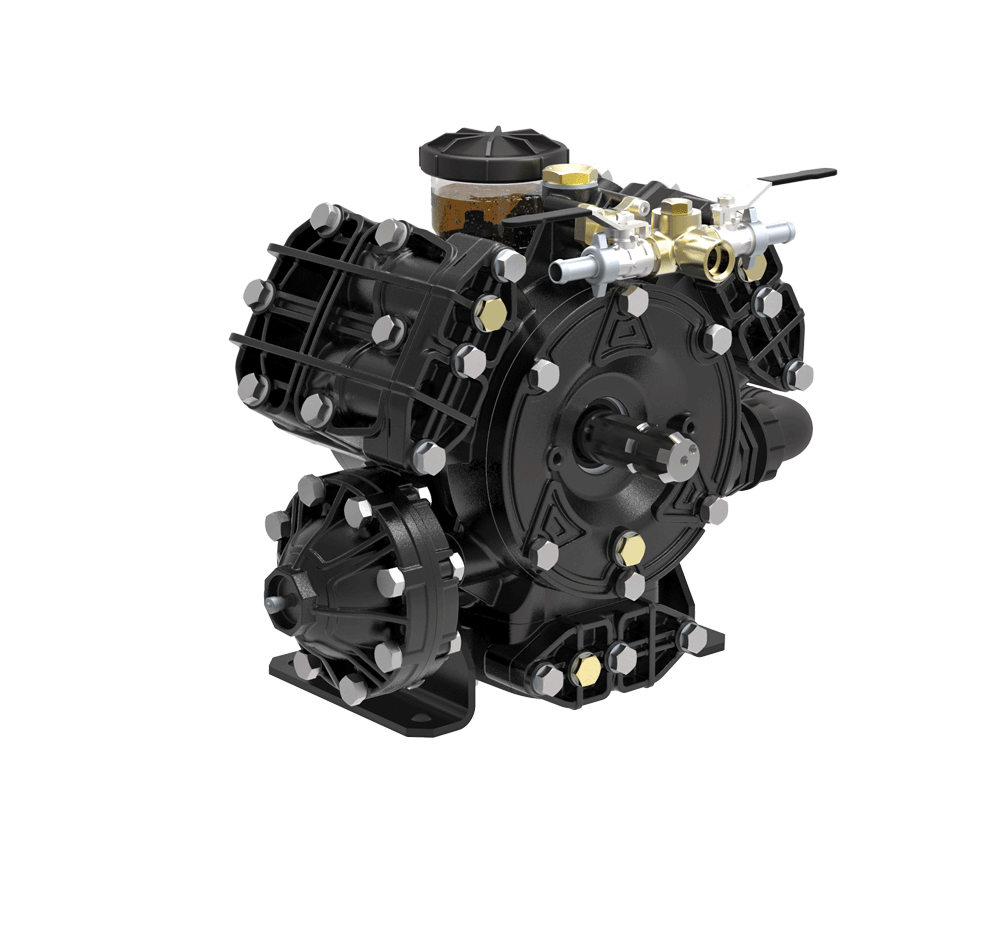
- Primary: Pratissoli MF7M7D (254 L/min at 75 bar, 36.4 kW)
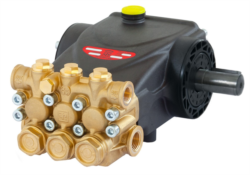
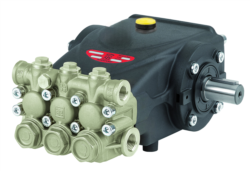
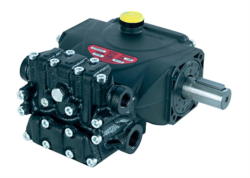
- Secondary: Two Interpump E1B1613 units in parallel (13 L/min each at 160 bar, 3.97 kW each)
Primary supplies 254 L/min continuously. If primary fails, secondary units automatically activate to deliver approximately 26 L/min—sufficient for essential process maintenance while repair crews work.
Section 2: Specification Matching and Equipment Selection
Critical Parameters: Displacement, Pressure, and RPM
When selecting backup equipment, matching specifications is non-negotiable. A mismatch in displacement or pressure rating creates operational risks:
Flow Matching:
Both units must deliver identical flow (L/min) at nominal operating RPM. If primary unit delivers 13 L/min at 1450 rpm, backup must also deliver 13 L/min at 1450 rpm—this ensures seamless switchover without pressure spikes or starvation.
Example specification pairing:
- Primary: Interpump E1B1613 – 13 L/min @ 1450 rpm, 160 bar
- Backup: Identical E1B1613 – 13 L/min @ 1450 rpm, 160 bar
Backup unit must equal or exceed primary unit's working pressure. Undersizing pressure rating creates valve relief cycling and heat generation during switchover. Oversizing is acceptable but increases equipment cost.
Power and RPM Compatibility:
Both units must draw power from the same motor or engine source. If primary is driven by 7.5 kW motor at 1450 rpm, backup must be compatible with that same power input.
Duty Cycle Considerations
Standby equipment endures unique stress profiles. A pump rated for continuous duty may fail prematurely if kept idle for months then suddenly subjected to full load. To manage this:
- Continuous Service Units: Purchase backup equipment rated for 100% continuous duty (ISO 16162 Class 2 or higher)
- Preventive Rotation: Every 4-6 weeks, run the standby unit at no load for 30-60 minutes to circulate oil through seals and prevent pump cavitation
- Oil Analysis: Sample fluid from both units quarterly to track wear metals and moisture ingress before failures occur
Section 3: Control Systems and Switchover Logic
Automatic Detection and Failover
Modern redundant systems use real-time monitoring to trigger switchover:
Pressure-Based Switchover:
A pilot-operated check valve in the primary line holds the backup valve closed during normal operation. When primary pressure drops below 90% of setpoint (indicating failure), the backup check valve opens automatically and supplies the load.
Flow-Based Detection:
For high-flow applications, flow meters on the primary line signal controllers to activate backup equipment if flow drops unexpectedly.
Dual Logic Control:
The most robust systems combine pressure and flow sensing with programmable logic controllers (PLCs) that:
- Monitor both units continuously
- Log failure events for root-cause analysis
- Switch loads with 50-100 ms latency (imperceptible to most processes)
- Alert operators via SCADA display when switchover occurs
- Prevent simultaneous operation (which would cause relief valve chattering)
Manual Override and Maintenance Modes
Automated systems must allow plant personnel to isolate and service equipment:
- Isolation Valves: Solenoid or manual ball valves on inlet and outlet of each pump allow technicians to service one unit while system operates on the other
- Test Mode: A selector switch allows operators to run backup unit at no load before emergency switchover (confirms readiness)
- Manual Switchover: A three-position valve lets operators choose primary, backup, or both units—critical if electronic controls fail
Section 4: Implementation and Maintenance Strategy
System Integration Checklist
When installing redundant Pumps & Compressors systems, verify:
1. Fluid Compatibility: Backup unit uses identical ISO grade hydraulic oil or pneumatic lubricant as primary unit
2. Port Sizing: All connection ports (inlet, outlet, pilot) are identical between units to prevent flow restrictions
3. Accumulator Sizing: For hydraulic systems, ensure accumulator volume accounts for both units' combined displacement during switchover transients
4. Relief Valve Settings: Primary and backup relief valves must open at identical pressure (within ±5 bar) to prevent nuisance relief cycling
5. Electrical Schematic: Document solenoid valve polarity, pilot pressure sources, and sensor wiring—critical for emergency troubleshooting
6. Testing Protocol: Before production startup, test switchover 10+ times at various load levels to confirm repeatability
Preventive Maintenance for Redundant Systems
Backup equipment failure defeats the purpose of redundancy. Implement:
Monthly Tasks:
- Visual inspection of both units for leaks, corrosion, or loose fasteners
- No-load runtime on standby unit (30 minutes) to prevent seal degradation
- Check solenoid valve pilot pressure and electrical coil resistance
- Oil analysis from both primary and backup units (wear metals, viscosity, water content)
- Full switchover test under 25%, 50%, and 75% load conditions
- Document switchover timing and pressure response
- Complete inspection and seal replacement on standby unit (even if no failure occurred)
- Rebuild or replace solenoid valve pilots
- Recalibrate all pressure sensors and flow meters
- Review failure logs and switchover events; analyze trends
Working with 3G Electric on Redundancy Planning
3G Electric's 35+ years as a global distributor means we've supported installations across diverse industries—automotive stamping, food processing, petrochemical, marine, and renewable energy. When designing redundant systems for your facility, our technical team can:
- Verify equipment compatibility based on your current system specifications
- Recommend specific backup unit models (e.g., Delta V4 RR pump 2.4 for oil circulation systems with 150µ filtration requirements)
- Provide schematic guidance for solenoid valve integration and pilot pressure routing
- Source identical units to ensure switchover reliability
- Support commissioning and acceptance testing
Conclusion: Redundancy as Strategic Asset Management
Plant downtime costs exponentially exceed equipment costs. A single 24-hour production stoppage in a mid-size automotive or chemical facility easily exceeds €50,000 in lost revenue, overtime labor, and customer penalties—yet redundant pumps or compressor systems cost €8,000–€20,000 to implement.
The decision to invest in redundancy should not be reactive (after a failure proves expensive) but proactive—built into capital planning when equipment is first specified. By choosing architecture appropriate to your process (active-active for partial tolerance, active-standby for zero-tolerance), matching specifications precisely, implementing automated switchover, and maintaining preventive discipline, you transform your Pumps & Compressors systems from cost centers into reliability assets that protect your plant's reputation and bottom line.
Contact 3G Electric to discuss redundancy specifications for your facility. We'll help you source the right backup equipment, verify compatibility, and support commissioning.