Understanding Pumps & Compressors Technology in Singapore Industrial Applications
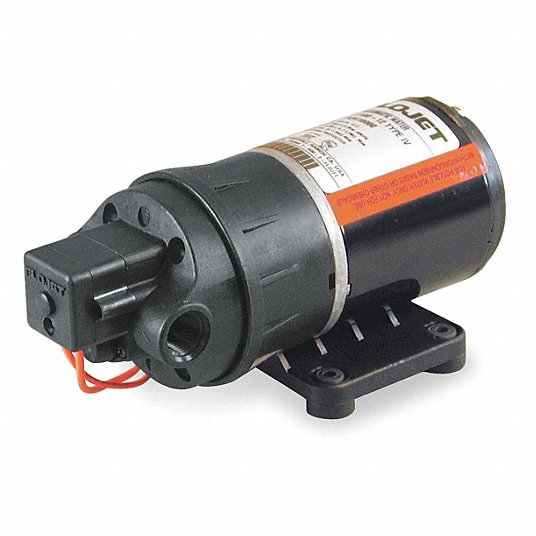
Singapore's manufacturing sector demands precision hydraulic systems where Pumps & Compressors performance directly impacts production efficiency and operating costs. With over 35 years of experience distributing industrial equipment, 3G Electric has guided thousands of professionals through pump selection decisions that balance technical requirements with budget constraints.
The fundamental choice between gear pumps and variable displacement pumps shapes system design, energy consumption, and maintenance protocols. Gear pumps operate on fixed displacement principles—delivering consistent flow at rated speed—while variable displacement pumps adjust output based on demand, enabling significant energy savings in dynamic applications.
Understanding these mechanical differences becomes critical when evaluating products like the Pratissoli KF30 (106 L/min, 200 bar) against higher-capacity alternatives. Each technology serves distinct operational environments with measurable efficiency and reliability implications.
Fixed Displacement Gear Pumps: Performance Specifications and Cost Advantages
Gear pumps represent the workhorse technology for Singapore's heavy manufacturing, food processing, and automotive sectors. Their simple design—two interlocking gears rotating within a housing—delivers reliability, predictable performance, and straightforward maintenance protocols that industrial teams can manage in-house.
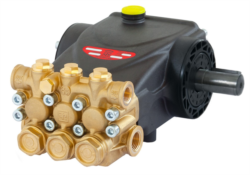
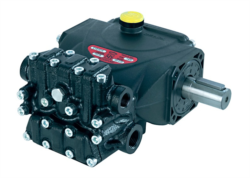
The Interpump PUMP E1D1808 L exemplifies compact gear pump engineering, delivering 8 L/min at 180 bar with just 2.72 kW input power. At 5 kg, this unit suits confined installation spaces common in retrofit projects where space constraints limit component sizing. Operating at a fixed 2800 rpm, technicians achieve predictable output without load-responsive controls, reducing system complexity and component count.
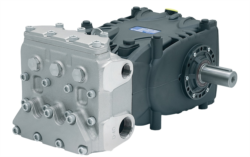
For mid-range industrial operations, the Pratissoli SS71153 offers substantial flow capacity (122 L/min) at 160 bar pressure, powered by a 37.5 kW motor running at 800 rpm. This lower rotational speed reduces noise and heat generation—critical considerations in Singapore's increasingly compact manufacturing facilities where vibration isolation and thermal management impact neighboring operations.
Key Gear Pump Advantages:
- Lower initial capital cost (typically 30-40% less than variable displacement models)
- Minimal maintenance requirements; fewer precision-engineered components
- Deterministic pressure relief characteristics; simplified system diagnostics
- Proven reliability across 15+ year operational lifecycles in tropical climates
- Straightforward pressure setting and adjustment protocols
A manufacturing facility running an 8-hour shift with continuous 122 L/min flow (SS71153) consumes approximately 300 kWh daily. At Singapore's industrial electricity rates (approximately SGD 0.25/kWh), daily energy cost reaches SGD 75. However, fixed displacement systems inherently waste energy through constant full-flow operation regardless of actual load demand. Pressure relief valves bypass excess flow as heat, creating compounding inefficiency in variable-load applications.
Gear pumps excel in constant-demand scenarios: hydraulic presses maintaining steady clamping pressure, conveyor systems with predictable flow requirements, or continuous extrusion operations. Initial equipment cost savings of SGD 8,000-15,000 compared to variable displacement alternatives can justify gear pump selection in capital-constrained operations.
Variable Displacement Pumps: Energy Efficiency and Load-Responsive Performance
Variable displacement technology enables flow output adjustment synchronized with actual system demand, fundamentally transforming energy consumption profiles. The Pratissoli KF30 represents this category's technical sophistication: 106 L/min capacity at 200 bar pressure with 40 kW rated power, yet consuming significantly less energy during partial-load operation.
Variable displacement pumps utilize swashplate mechanisms that physically adjust pump displacement in response to system pressure feedback. When hydraulic circuits require reduced flow—during holding phases, idle periods, or partial actuation—the pump automatically reduces displacement, minimizing energy waste through bypass flow.
The Pratissoli MW40 high-performance industrial pump (211 L/min, 210 bar, 85 kW) demonstrates variable displacement advantages in larger installations. This unit operates across diverse load conditions: delivering full 211 L/min during peak production cycles while reducing displacement during maintenance intervals, tool changes, or production ramp-down phases.
Variable Displacement Technology Benefits:
- Energy consumption tracks actual demand: 40-60% reduction in typical manufacturing cycles
- System temperature reduction through minimized bypass flow and heat generation
- Quieter operation due to reduced unloaded pump circulation
- Extended component lifespan; lower thermal stress on seals, valves, and manifolds
- Responsive load control enabling sophisticated process optimization
Consider a plastic injection molding facility requiring variable hydraulic flow: 150 L/min during mold closing/injection, 80 L/min during cooling, 20 L/min during part ejection, 10 L/min during idle holding.
Fixed displacement (gear pump at 150 L/min constant): Operating 8 hours daily with 40 bar average relief pressure:
- Theoretical power: 150 L/min × 40 bar ÷ 600 = 10 kW
- Actual power with losses: 12.5 kW × 8 hours = 100 kWh daily
- Monthly energy cost: 2,400 kWh × SGD 0.25 = SGD 600
Variable displacement (swashplate pump with pressure-compensated control):
- Average operating point: 85 L/min × 35 bar = 4.96 kW
- Actual power with losses: 6.2 kW × 8 hours = 49.6 kWh daily
- Monthly energy cost: 1,190 kWh × SGD 0.25 = SGD 298
Practical Selection Framework: Matching Pump Technology to Singapore Industrial Operations
Gear Pump Recommendation Criteria:
- Constant or predictable flow demand operations
- Confined installation spaces (retrofit scenarios, compact machine integration)
- Minimal maintenance budget or in-house technical capability
- Pressure requirements below 210 bar
- Operations with <5 year equipment replacement cycles
- Budget-constrained manufacturing (
- Dynamic load profiles with significant idle or partial-flow periods
- Sustainability/energy efficiency mandates or green certification requirements
- Continuous operations (>16 hours daily) where energy savings compound
- Sophisticated process control requiring responsive pressure management
- High ambient temperatures where thermal management prevents overheating
- Operations planning 10+ year equipment lifecycles with total-cost-of-ownership analysis
Interpump E-Series Compact Pumps: Specialized Applications and Integration Advantages
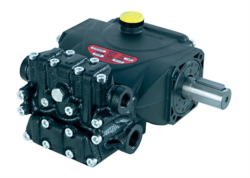
The Interpump ET1C1612 SX*D20 represents emerging compact pump technology suited to Singapore's precision manufacturing environment. Operating at 12 L/min and 160 bar with PTFE construction, this unit serves high-pressure hydraulic circuits in confined spaces without system redesign.
Compact pump advantages address specific industrial challenges:
Space Constraints: Modern Singapore manufacturing facilities optimize floor space aggressively. Compact pumps enable hydraulic system integration into machine bases, eliminating separate pump stations and associated hose routing complexities.
Thermal Management: Tropical Singapore climate creates ambient temperature challenges. Compact pumps reduce system oil volume, improving cooling efficiency and preventing thermal degradation during extended operation.
Modular System Design: Smaller displacement units enable redundancy strategies unavailable with large centralized pumps. Distributed pump architecture improves reliability through compartmentalized failure isolation.
Maintenance Access: Compact units integrate into machine envelopes, improving technician access during service intervals and reducing production downtime during preventive maintenance.
Maintenance Implications and Total Cost of Ownership Analysis
Pump selection profoundly impacts maintenance protocols and operational reliability. Gear pump maintenance emphasizes visual inspection, fluid condition monitoring, and pressure relief valve validation. Technicians typically perform in-house maintenance during planned shutdowns, minimizing service call costs.
Variable displacement pumps require specialized diagnostics: swashplate condition assessment, pressure-compensating spool functionality verification, and load-sensing signal circuit validation. Singapore's industrial service providers charge SGD 200-400 per hour for variable displacement pump diagnostics. Complex repairs often necessitate component replacement rather than field repair, creating 2-3 week lead times for imported units.
However, variable pumps' superior energy efficiency often generates maintenance cost offsets through reduced system stress. Lower operating temperatures extend seal and bearing lifespan by 30-50%, reducing unplanned failures and emergency service calls.
Total Cost of Ownership (12-year horizon):
Gear Pump Model: Equipment cost SGD 15,000 + Energy SGD 28,800 (annual) + Maintenance SGD 3,000 (annual) = Total SGD 411,800
Variable Displacement Model: Equipment cost SGD 28,000 + Energy SGD 14,400 (annual) + Maintenance SGD 4,500 (annual) = Total SGD 257,200
Annual Savings: SGD 12,133 favoring variable displacement in energy-intensive operations.
3G Electric's 35+ years of industrial equipment distribution across Southeast Asia demonstrates that sophisticated total-cost-of-ownership analysis consistently favors variable displacement technology in applications operating beyond 6,000 annual hours. Initial equipment cost premiums rapidly amortize through energy savings and reduced maintenance intervention.
Selection Decision Tree for Singapore Industrial Professionals
Prioritize selection factors in sequence: (1) Flow/pressure requirements, (2) Duty cycle profile, (3) Installation constraints, (4) Energy cost budget, (5) Maintenance capability, (6) Equipment lifecycle expectations.
A facilities manager evaluating the Pratissoli KF30 versus Interpump E1D1808 L should assess: Does your application require 106 L/min sustained flow (KF30) or can you operate at 8 L/min with higher pressure compensation? Single-answer clarification immediately eliminates one product category.
Second assessment: What is your actual annual pumping hours? Operations exceeding 5,000 hours annually justify variable displacement complexity and cost. Operations below 3,000 hours favor gear pump economics.
Third factor: Available maintenance support. Facilities with in-house technicians benefit from gear pump simplicity. Facilities relying on external service calls benefit from variable pump efficiency reducing service frequency.
This systematic approach ensures equipment selection aligns with operational reality rather than generic industry recommendations. 3G Electric's technical team supports this evaluation process, providing specification sheets, energy consumption models, and field performance data across competing product lines.