Controls & Safety: Sensor Redundancy and Multi-Channel Detection Architecture
For procurement engineers specifying burner control systems in Singapore's industrial sector, sensor redundancy and multi-channel detection represent a fundamental shift from single-point-of-failure architectures to fault-tolerant designs. With over 35 years of experience distributing industrial equipment, 3G Electric has observed that systems incorporating dual or triple detection pathways reduce unplanned shutdowns by 40–60% compared to single-detector installations.
Sensor redundancy is not simply installing two flame detectors—it requires strategic component selection, signal processing architecture, and verification logic that ensures both safety and operational continuity. This article explores how procurement engineers can specify, evaluate, and implement multi-channel detection systems that meet local regulatory standards and industrial best practices.
Understanding Multi-Channel Detection Architecture
Multi-channel detection refers to systems that employ two or more independent flame detection pathways, each capable of monitoring combustion independently. In industrial burner applications—particularly those serving Singapore's petrochemical, manufacturing, and district heating sectors—multi-channel designs address three critical failure modes:
- Sensor degradation: Fouling, contamination, or age-related sensitivity loss in a single detector
- Electronic failure: Amplifier malfunction, connector corrosion, or signal processing errors
- Environmental interference: Ambient light, electromagnetic noise, or vibration affecting detector output
When both channels deliver independent signals to a voting logic circuit, the system can differentiate between genuine flame presence and spurious signals. This architecture is mandated by PED (Pressure Equipment Directive) compliance and strongly recommended under Singapore's ACRA industrial safety guidelines.
Channel Independence and Sensor Selection
True redundancy requires that detection channels operate on fundamentally different physical principles. A common architecture pairs:
- Ultraviolet (UV) detection: Primary path using instruments like the Honeywell Cell C 7044 A 1006, which responds to UV radiation from hydrocarbon combustion (200–300 nm wavelength)
- Infrared (IR) detection: Secondary path monitoring 4.4 µm carbon dioxide emission or 3.3 µm hydrocarbon radiation
UV detectors inherently reject solar interference (which is mainly visible and near-IR), making them ideal for daytime outdoor installations. However, UV sensitivity degrades in environments with persistent dust or combustion residue. IR channels complement this by maintaining consistent response in contaminated atmospheres.
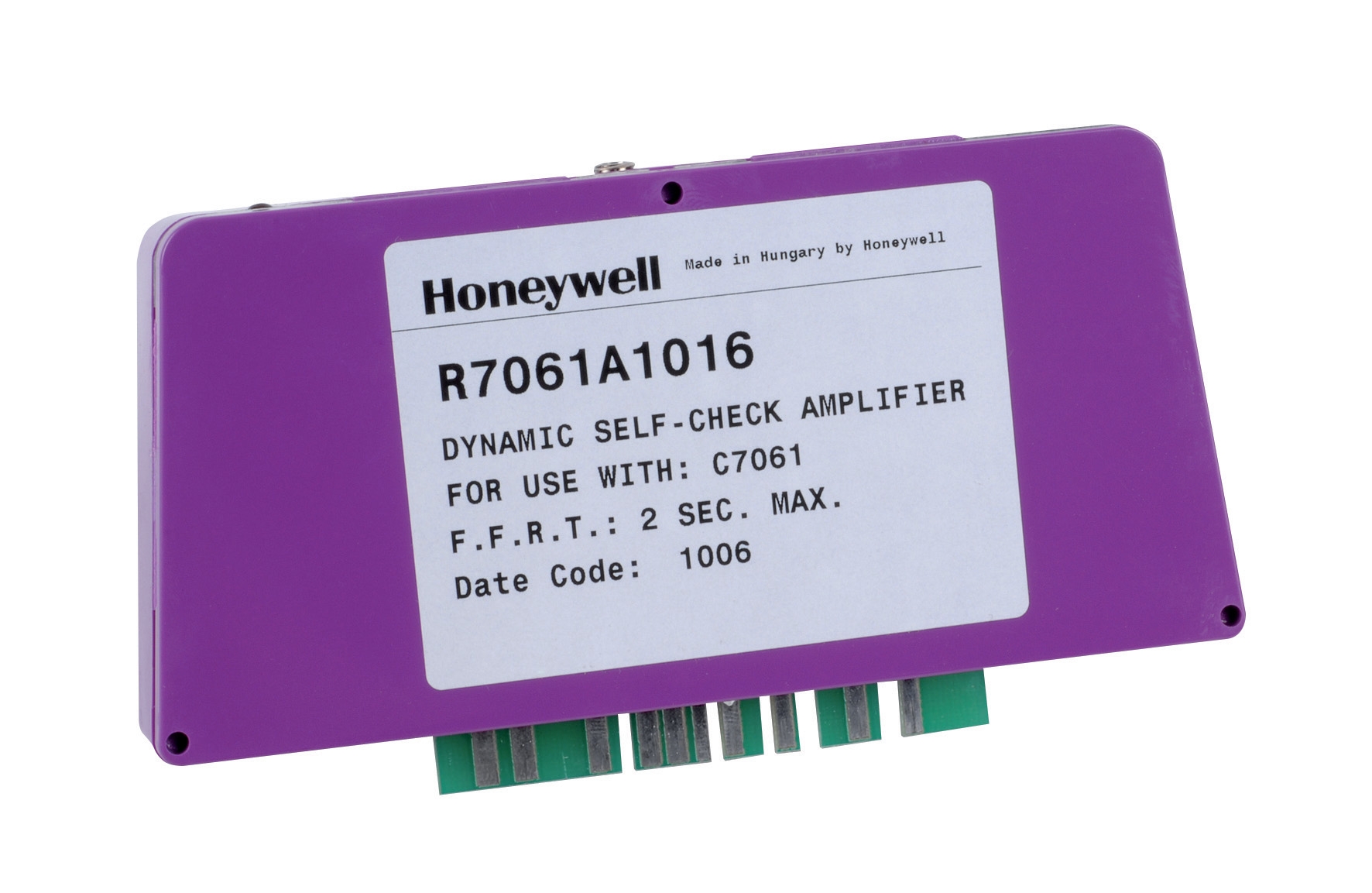
When specifying dual-channel systems, procurement engineers must verify that each amplifier—such as the Honeywell Amplifier R 7861 A 1026—operates across the full industrial vibration envelope (0.5 g continuous, per design specification) and maintains signal integrity at temperature extremes (-40°C to 60°C).
Signal Processing and Voting Logic
Multi-channel architectures implement three common voting strategies:
1. AND Logic (Conservative)
- Both channels must confirm flame for burner ignition
- Reduces false alarms but increases false flame-out risk if one channel fouls
- Suitable for systems where energy interruption cost is low relative to safety criticality
- Either channel can maintain burner operation
- If one channel fails, the other sustains combustion
- Automatic solenoid valve closure occurs only if both channels simultaneously signal "no flame"
- Requires monitored diagnostic circuits to alert operators to single-channel degradation
- Each channel assigns a confidence value (0–100%) based on signal stability and rate of change
- System maintains flame if combined confidence exceeds threshold (typically 70–80%)
- Automatically downrates channels showing age-related drift or noise
- Enables predictive maintenance alerts 200–400 hours before complete sensor failure
The Pactrol CSS01 12 housing control module implements standard OR logic with integrated flame relay and timed safety lockout, suitable for atmospheric and small forced-air burners up to 60 kW. For larger installations or advanced requirements, distributed control architectures with microprocessor-based voting logic are recommended.
Thermal Compensation and Sensor Cross-Coupling
When multiple detectors are mounted within a burner envelope, thermal cross-coupling becomes a critical design consideration. UV detectors employ quartz windows (transparent to UV but opaque to IR), while IR detectors use selective optical filters. If both detectors view the same flame from identical angles, they become correlated—a simultaneous failure mode can occur if combustion geometry changes unexpectedly.
Best practice for procurement specifications:
- Position UV and IR detectors at 45–90° angles to one another
- Ensure each detector has independent optical isolation (separate flame tubes or baffles)
- Verify that amplifier input impedance (typically 10 MΩ) does not create capacitive coupling between channels
- Specify shielded twisted-pair cabling (not single-ended) for detector signal lines
Temperature compensation is integral to robust detection. Professional-grade amplifiers, such as the R7861A 1026, incorporate automated gain adjustment across the -40°C to 60°C range, ensuring that cold-start detection sensitivity does not degrade at elevated burner temperatures. When evaluating multi-channel systems, confirm that each amplifier's compensation circuit operates independently—a shared compensation feedback loop would re-introduce correlation between channels.
Specification and Procurement Workflow for Redundant Systems
For procurement engineers in Singapore, the specification workflow for multi-channel detection should follow these steps:
Step 1: Define System Architecture Requirements
- Determine whether AND, OR, or weighted voting logic is required based on application risk profile
- Document thermal environment (burner surface temperature, ambient air temperature, seasonal variation)
- Specify expected soiling rate (months between window cleaning in typical duty cycle)
- Define diagnostic alert requirements (local display, SCADA integration, email notification)
Step 2: Component Selection and Compatibility Verification
- Select primary detector (e.g., Honeywell Cell C 7044 A 1006 for UV) with published response curve and spectral sensitivity data
- Pair with complementary secondary detector from different optical principle
- Confirm both amplifiers are rated for identical current loop (typically 4–20 mA), voltage range (typically 24 VDC ±10%), and response time (minimum 200 ms per PED)
- Verify mechanical compatibility: tube size, flame tube mounting thread, optical window material for corrosive environments
Step 3: Environmental Qualification
- Request test data showing detector stability under application-specific contaminants (e.g., sulfur compounds in oil-fired systems, alkali metals in biomass burners)
- Confirm amplifier EMC compliance to EN 61326-1 (industrial measurement equipment) and rated vibration per ISO 6954
- Document fail-safe default (detectors should signal "no flame" on power loss or open-circuit cable)
Step 4: System Integration and Commissioning Planning
- Specify interlock logic: if one channel fails, shall the system revert to single-channel operation or demand immediate shutdown?
- Define diagnostic parameter thresholds: at what signal drift rate should predictive maintenance alerts trigger?
- Plan for field calibration: both UV and IR detectors require reference flame verification during commissioning; budget 4–6 hours of technician time per burner
- Document changeover procedures if upgrading existing single-channel systems; verify that legacy solenoid valve response time (typically 80–150 ms) is compatible with new amplifier timing
Practical Implementation: Case Study in Singapore's Manufacturing Sector
A Singapore-based food processing facility operates three parallel boilers (each 80 kW oil-fired) serving a district heating network. Original single-UV-detector design experienced an average of 2.1 unwanted shutdowns per month due to detector window fouling during high-soot production periods.
After retrofitting with paired UV/IR detection using OR logic voting:
- UV detector mounted at 0° (primary flame observation angle)
- IR detector mounted at 60° (secondary, monitoring combustion chamber radiation)
- Both channels processed through independent 4–20 mA loops into a microprocessor relay module
- Diagnostic logic triggered maintenance alert if either channel signal drifted >15% from baseline over 48 hours
Results:
- Unplanned shutdowns reduced to 0.2 per month (90% reduction)
- Maintenance team now cleans UV windows on 6-month schedule (predictable) instead of emergency basis
- System cost premium: approximately 18% above single-detector design
- Payback period via reduced downtime: approximately 14 months
The key procurement decision was selecting detectors with published cross-sensitivity data. The facility verified that the chosen UV detector responded <1% to visible and IR light sources, enabling confident diagnosis when the IR channel alone triggered (indicating UV window fouling rather than flame loss).
Design Verification and Testing Protocols
Procurement engineers should mandate the following factory acceptance tests (FAT) for multi-channel systems:
1. Dual-Channel Detection Proof
- Energize both amplifiers and confirm each generates independent 4–20 mA output during controlled test flame
- Document signal values at 20%, 50%, and 100% flame intensity
- Verify that if one amplifier is disconnected, the system continues to operate via the remaining channel
- Simulate open-circuit fault in each detection channel (one at a time)
- Confirm solenoid dump valve closes within 5 seconds
- Verify alarm output activates on safety relay module
- Time interval from flame extinction to solenoid closure shall not exceed 3 seconds (per PED Article 4.10)
- Measure for each channel independently and for simultaneous multi-channel shutdown
- Apply 50 A short-circuit current in adjacent power cables; confirm no false flame signals
- Expose detector to ambient light (1000 lux LED white light) and radiant heat (IR lamp, 200 W)
- Verify output signal remains stable and within ±5% of baseline
- Operate system at 55°C ambient for minimum 8 hours
- Document amplifier output drift; shall not exceed ±3% from 25°C baseline
- Repeat at -10°C (simulating cold-start conditions in unheated equipment rooms)
These tests are typically conducted in 2–3 days and should be documented in a formal FAT report before system shipment from supplier or upon arrival at site.
Integration with Modern Control Platforms
Contemporary multi-channel detection systems integrate with Building Management Systems (BMS) and Industrial IoT platforms via standardized protocols:
- BACnet MS/TP: Common in Singapore's HVAC sector; detectors report channel status as binary inputs + analog 4–20 mA
- Modbus RTU: Preferred for retrofit applications; enables remote diagnostics and channel-level reporting
- OPC UA: Enterprise integration for large multi-site operations; supports predictive analytics and anomaly detection
When specifying integration, confirm that the amplifier and voting module support:
- Configurable alarm thresholds (channel 1 sensitivity, channel 2 sensitivity, AND/OR voting logic)
- Accessible diagnostic registers (signal level, response time measurement, failure history)
- Event logging with timestamps (useful for forensic analysis after unplanned shutdowns)
Conclusion
Multi-channel detection architecture with sensor redundancy has evolved from a premium safety feature to an industry-standard requirement in Singapore's regulated industrial sectors. For procurement engineers, the strategic value lies not in cost minimization but in lifecycle cost reduction—systems designed with dual independent detection pathways generate measurable returns through reduced unplanned downtime, extended maintenance intervals, and compliance with emergent PED and local authority regulations.
3G Electric's 35-year track record in industrial equipment distribution reflects the maturation of these technologies. The products referenced—including the Honeywell Cell C 7044 A 1006 UV detector and R7861A 1026 amplifier—represent proven platforms for multi-channel implementations across diverse industrial applications.
Successful procurement requires clear specification of voting logic, independent channel verification protocols, and integration with existing control infrastructure. Budget for professional commissioning support, especially during initial system tuning; the 4–6 hour investment in field calibration typically yields 18–36 months of trouble-free operation before routine maintenance is required.