Understanding Multi-Component System Selection for Industry Applications
Industry applications across manufacturing, food processing, petrochemical, and HVAC sectors increasingly demand integrated solutions that combine combustion efficiency, precise atomization, and real-time temperature monitoring. Unlike single-component purchases, procurement engineers today must evaluate equipment that works together—gas burners feeding fuel to heating vessels, oil nozzles atomizing coatings or fuel, and thermal probes ensuring safe operation.
3G Electric's 35+ years distributing industrial equipment across global markets has shown that the most reliable operations pair high-efficiency burners with complementary nozzle and control systems. The challenge: each industry application has different requirements for power output, spray pattern, temperature tolerance, and operational reliability.
This article compares four critical equipment categories—complete gas burner assemblies, full-cone oil nozzles, precision spray systems, and digital temperature sensors—to help you build robust, application-specific solutions for your facility.
Gas Burner Systems: Power Output and Modulation Capabilities
Complete Burner Assemblies vs. Standalone Flame Stabilization
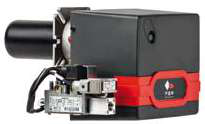
The FBR X GAS X0 CE TC + RAMPA CE D1/2"-S (methane variant) represents a complete gas burner assembly designed for modulating industrial heating. This system delivers 11.6 kW to 34.3 kW with a 90 mm nozzle, engineered for applications requiring variable heat input without flame extinction during load changes.
Key performance considerations for procurement:
- Modulation Range: The continuous 11.6–34.3 kW delivery means your facility can maintain stable combustion across variable production schedules (e.g., preheating at lower load, full-speed processing at peak capacity).
- Nozzle Specification: The 90 mm nozzle accommodates gas flow rates typical in medium-scale industrial furnaces, dryers, and thermal processing equipment—common in automotive component heating, textile dyeing, and food processing.
- CE Compliance: Built-in regulatory certification simplifies procurement for European and globally harmonized markets, reducing delays for facilities needing certified equipment.
- Gas Train Integration: Complete gas train means all safety components (pressure regulation, flame safeguard, fuel isolation) arrive as a tested assembly, not requiring field integration of separate components.
Atomization Systems: Oil Nozzles for Spray-Critical Applications
Full-Cone Nozzles: Flow Rate, Spray Angle, and Pressure Matching
Two full-cone oil nozzle options address different throughput requirements:
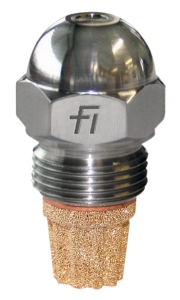
Jetoil 3.50 80° S: This nozzle delivers 0.40 to 35.00 GPH (gallons per hour) with an 80° spray angle, positioning it for high-volume applications. Common industry applications include:
- Industrial burner primary fuel atomization (larger furnaces, boilers)
- Spray-coating operations in automotive and metalwork facilities
- Lubrication systems requiring broad distribution across wide surfaces
- Waste fuel incineration where high flow rates prevent fuel accumulation
- Small-scale burner systems in modular or laboratory equipment
- Fine-mist lubrication of precision machinery (spindle bearings, forming dies)
- Industrial spray coating where narrower patterns reduce overspray waste
- Temperature-sensitive processes where large droplets cause thermal shock
| Parameter | Jetoil 3.50 80° S | CBM Fluidics 0.50 60° SF |
|-----------|-------------------|-------------------------|
| Flow Range | 0.40–35.00 GPH | ~0.37 GPH fixed |
| Spray Angle | 80° (broad) | 60° (narrow) |
| Typical Pressure | Varies by capacity | 10 bar nominal |
| Best Use Case | High-volume heating, coating | Precision atomization, lubrication |
| Cost Consideration | Higher throughput = more fuel value | Lower cost per unit for small systems |
When specifying oil nozzles, verify three critical parameters: (1) system pressure (does your pump deliver the required bar/psi?), (2) desired flow rate (matched to burner or coating equipment specifications), and (3) spray pattern compatibility with vessel or application geometry. Undersizing nozzles creates incomplete atomization and poor fuel economy; oversizing wastes energy and may overwhelm burner capacity.
Temperature Monitoring and System Safety
Digital Thermal Probes for Process Control
The Fantini Cosmi LS150 thermocouple J probe measures temperature from 0 to 450°C with ±2.5°C precision, featuring stainless steel AISI 316 construction and IP65 environmental protection. This component becomes critical when integrating combustion and atomization systems into larger manufacturing workflows.
Industry application scenarios requiring accurate thermal feedback:
1. Food Processing: Pasteurization vessels, cooking kettles, and dryer drums need ±2°C accuracy to maintain product safety and quality. Undershooting temperature allows pathogen survival; overshooting damages nutrients and flavor.
2. Petrochemical Cracking: Precise temperature control in reforming furnaces directly impacts product yield and energy efficiency. A 5°C deviation can cost thousands in lost throughput.
3. Textile and Coating Dyeing: Temperature stability within 2–3°C ensures consistent color matching and coating thickness across production batches.
4. HVAC and Thermal Systems: Building climate control systems rely on probe feedback to modulate burner output, preventing overheating and energy waste.
Probe selection criteria for procurement:
- Thermocouple Type: Type J probes (iron-constantan) excel in 0–500°C ranges with fast response times, ideal for burner-integrated systems. Type K extends to 1000°C but with slower response, better suited for furnace monitoring.
- Sheath Material: AISI 316 stainless steel resists corrosion in industrial atmospheres with high moisture or acidic vapor; standard stainless (304) suffices for drier environments and costs less.
- IP Rating: IP65 (dust-tight, water jet resistant) works for most manufacturing floors. IP67 (submersible to 1 meter) needed only in washdown environments.
- Immersion Length: Longer probes (150–300 mm) penetrate hot zones for accurate readings; shorter probes (50–75 mm) fit compact vessel designs.
Integrated System Strategy: Matching Components for Real-World Applications
Example 1: Industrial Furnace for Metal Heat Treatment (Small to Medium Facility)
Requirement: Heat steel components to 800°C, maintain ±10°C stability, process 2,000 kg/day.
Recommended system:
- Combustion: FBR X GAS X0 CE TC (11.6–34.3 kW range provides modulation during batch changes)
- Fuel Atomization: Jetoil 3.50 80° S (supports full combustion output with broad flame pattern)
- Temperature Control: Fantini Cosmi LS150 positioned at furnace exit to feedback temperature to burner control system
- Procurement Approach: Buy burner assembly as single unit; specify nozzle flow rate matching burner max capacity; install probe with digital controller (third-party PID unit) to modulate fuel valve.
Example 2: Precision Lubrication System for CNC Machining Center
Requirement: Apply micro-mist coolant to cutting tool, improve tool life by 40%, reduce overspray waste.
Recommended system:
- Combustion: Not needed; skip burner component
- Atomization: CBM Fluidics 0.50 60° SF (low flow, narrow spray angle reduces coolant waste)
- Temperature Monitoring: Fantini Cosmi LS150 monitors coolant temperature; overheating reduces viscosity and cooling effectiveness
- Procurement Approach: Integrate precision nozzle with existing lubrication pump (verify 10 bar pressure capability); add thermal probe and simple mechanical thermostat to bypass excess coolant to tank if temperature exceeds 50°C.
Example 3: Wastewater Treatment Thermal Disinfection Unit
Requirement: Heat municipal wastewater to 65°C to reduce pathogens, process 500 m³/day, operate 24/7.
Recommended system:
- Combustion: FBR X GAS X0 CE TC (modulation essential for variable incoming water temperature)
- Fuel Atomization: Jetoil 3.50 80° S or CBM option depending on existing burner port size (field installation determines choice)
- Temperature Control: Fantini Cosmi LS150 monitors outlet water; probe mounted in secondary heat exchanger to prevent scalding and energy waste
- Procurement Approach: Specify complete burner assembly for simplicity (municipal utilities prioritize reliability over flexibility); select nozzle based on engineering drawings; install two probes—one at inlet (monitor inflow), one at outlet (control setpoint).
Practical Procurement Checklist for Multi-Component Systems
Before finalizing orders, answer these seven questions:
1. Power Output Match: Does your burner's maximum kW output exceed 80% of your thermal requirement? (Avoid undersized units; 15–20% safety margin ensures stable modulation.)
2. Nozzle Pressure Compatibility: Does your fuel pump deliver the nozzle's rated pressure (e.g., Jetoil at system pressure, CBM at 10 bar)? Mismatches cause poor atomization or equipment damage.
3. Spray Pattern Coverage: Does the nozzle's spray angle and flow rate distribute fuel evenly across your combustion chamber? Narrow 60° patterns miss large furnaces; broad 80° patterns oversaturate small burners.
4. Thermal Probe Placement: Can you install the thermocouple probe in a location that reaches temperature equilibrium with your process (not in stagnant dead zones)?
5. Control System Compatibility: Do you have a control unit (PLC, simple thermostat, or integrated burner controller) that accepts the probe's output signal?
6. Spare Parts Availability: Are consumables (nozzles, filters, probe replacements) available within 2–3 weeks? Exotic equipment creates long lead times during breakdowns.
7. Regulatory Certification: Does the system meet your region's safety standards (CE for Europe, UL for North America, CSA for Canada)? The FBR X GAS X0 CE TC provides EU compliance; verify others with your compliance officer.
Conclusion: Strategic Equipment Selection Reduces Total Cost of Ownership
3G Electric's global experience shows that procurement engineers who treat combustion, atomization, and temperature control as an integrated system—rather than purchasing components separately—achieve 15–25% lower total cost of ownership through improved uptime, reduced troubleshooting, and optimized energy use.
The equipment discussed here spans applications from furnace heating to lubrication cooling, accommodating small custom facilities and large municipal operations. Success depends on matching each component's specification to your specific duty cycle and connecting them through a control architecture your maintenance team understands.
Start by defining your thermal requirement (kW needed), then work backward: select a burner with adequate modulation; size the nozzle to the burner's maximum fuel delivery; choose a thermal probe compatible with your process temperature range; integrate all three through your control system. This systematic approach transforms procurement from a checklist exercise into a strategic investment in operational reliability.