Understanding Burners & Combustion Performance Classes
Burners & Combustion equipment operates across three distinct performance tiers, each serving different industrial heating requirements and regulatory zones. With over 35 years of experience distributing industrial equipment globally, 3G Electric has observed that maintenance teams often struggle to align burner specifications with both thermal demands and emissions compliance.
The critical distinction lies not just in output capacity, but in how different burner architectures achieve combustion efficiency at varying load conditions. Single-stage burners operate at fixed output, while progressive multi-stage systems modulate across load ranges. Heavy-oil burners deliver maximum thermal capacity but require robust fuel conditioning, whereas light-oil systems offer cleaner operation with lower maintenance overhead.
Light-Oil Single-Stage Burners: Compact Efficiency for Strict Emission Zones
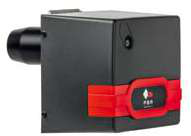
The FBR X G OSR 2003 TC R S represents the entry-level solution for facilities operating in tight emissions compliance regions. This single-stage light-oil burner delivers 14.2–36.7 kW thermal output while maintaining NOx emissions below 120 mg/kWh—critical for zones requiring Euro 4 or equivalent standards.
Key Performance Characteristics:
- Fixed-output combustion (no modulation)
- Fuel consumption: 1.0–2.6 kg/h
- Operating pressure: 1N~2N (single-phase supply)
- Ideal for: Boilers, space heaters, small-to-medium furnaces
- Maintenance advantage: Simpler control logic, fewer pressure-sensitive components
Maintenance teams appreciate this class because single-stage operation eliminates modulation-related tuning issues. Flame stability remains constant across the operating window, reducing thermal cycling stress. However, the trade-off is energy inefficiency during partial-load conditions—the burner runs at full capacity even when facility demand drops below peak output.
When to specify: Facilities with predictable, steady-state heating loads and stringent local emissions regulations (EU Directive 2014/68/EU, China GB 13271-2014, or equivalent).
Light-Oil Progressive Two-Stage Burners: Balanced Capacity and Efficiency
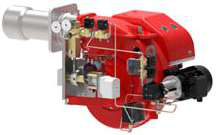
The FBR FGP 130/M TC EVO SA bridges the gap between single-stage simplicity and heavy-duty capacity. This progressive two-stage diesel burner delivers maximum thermal output of 1,326 Mcal/h (1,542 kW) with fuel flow to 130 kg/h, using staged combustion to modulate between low and high firing rates.
Key Performance Characteristics:
- Two-stage modulation: 30–100% thermal output range
- Fuel type: Light diesel oil (DIN 51603)
- Ignition: Spark electrode with integrated flame detection
- Typical modulation ratio: 1:3 (low-fire at ~33% capacity)
- Operating pressure: 3~400V three-phase supply
- Noise level: 82–86 dBA (typical)
The two-stage architecture allows the burner to start at reduced output (stage 1, ~40% capacity) and ramp to full fire (stage 2) only when system demand requires it. This approach delivers three tangible benefits for maintenance teams:
1. Thermal cycling reduction: Lower ignition stress extends electrode and nozzle service life by 30–40% versus fixed-output systems
2. Fuel cost control: Partial-load operation consumes 25–35% less fuel during off-peak heating periods
3. Flame stability improvement: Two-stage systems exhibit lower CO emissions during low-fire operation (typically <100 ppm vs. 150+ ppm for single-stage at part load)
When to specify: Industrial applications with variable demand (textile drying, food processing, chemical batch heating) and moderate emissions zones (EU Stage 3b, US EPA non-attainment areas).
Heavy-Oil Dual-Fuel Burners: Maximum Capacity for Industrial-Scale Operations
The FBR KN 550/M TL EL represents the high-capacity tier—a dual-fuel heavy-oil burner delivering 698–6,395 kW across two modulating stages. This equipment dominates large-scale industrial heating, power generation, and district heating networks.
Key Performance Characteristics:
- Dual-fuel capability: Heavy fuel oil (HFO) and light diesel oil (DL)
- Two-stage modulation: 10–100% thermal output range
- Fuel flow capacity: 0.5–46.2 t/h
- Operating pressure: 3~400V three-phase supply
- Electrical protection: IP40 enclosure rating
- Noise generation: 87–91 dBA (typical)
- Modulation response: ≤10 seconds stage transition
Dual-fuel flexibility allows operations to switch between heavy oil (typically 20–40% lower cost in bulk markets) and light diesel (faster ignition, lower viscosity management). The 10–100% modulation ratio means the burner can operate efficiently across its entire capacity range—critical for facilities with fluctuating steam or hot-water demand.
However, heavy-oil systems demand more rigorous maintenance:
- Fuel pre-heating (60–100°C) to reduce viscosity and improve atomization
- Daily strainer inspections (sediment accumulation reduces nozzle lifespan)
- Quarterly fuel-line flushing to prevent carbon buildup in injectors
- More frequent electrode replacement due to carbon residue on ignition surfaces
When to specify: Large industrial facilities (>5 MW thermal demand), district heating operators, and regions where heavy oil is the dominant industrial fuel (Middle East, South Asia, Russia).
Comparative Performance Matrix for Maintenance Decision-Making
Thermal Output vs. Fuel Consumption
The FBR X G OSR 2003 TC R S delivers 36.7 kW maximum output at 2.6 kg/h fuel consumption—a ratio of 14.1 kW per kg/h. The FBR FGP 130/M TC EVO SA achieves 1,542 kW at 130 kg/h—a ratio of 11.9 kW per kg/h. The heavy-oil FBR KN 550/M TL EL operates at 6,395 kW and 46.2 t/h—a ratio of 13.8 kW per kg/h.
This reveals a critical insight: larger burners achieve slightly lower thermal efficiency per unit of fuel. The difference (11.9–14.1 kW/kg) stems from larger nozzles requiring marginally higher excess air for complete combustion. For maintenance teams, this means:
- Small burners: 85–88% combustion efficiency
- Medium burners: 83–86% combustion efficiency
- Large burners: 81–85% combustion efficiency
The 3–5% efficiency gap is offset by heavy-oil fuel cost savings in bulk procurement—a key consideration for facilities with 5,000+ annual operating hours.
Emissions Performance Across Burner Classes
The single-stage light-oil burner maintains NOx below 120 mg/kWh through optimized air-fuel ratio control. Progressive burners like the FBR FGP 130/M TC EVO SA typically deliver 150–180 mg/kWh due to temperature variations during stage transitions. Heavy-oil burners typically range 200–280 mg/kWh depending on fuel sulfur content and combustion air temperature.
Maintenance implication: If your facility operates in an emissions-critical zone (urban area, Class I airshed, or region with pending regulations), specify single-stage or advanced low-NOx burners now—retrofitting to meet future emissions limits costs 3–5× more than original installation.
Modulation Range and Partial-Load Efficiency
Single-stage burners: 0% or 100% operation only (on-off cycling)
- Partial-load efficiency: 60–70% of full-load efficiency
- Thermal cycling stress: Highest (frequent ignition events)
- Partial-load efficiency: 75–85% of full-load efficiency
- Thermal cycling stress: Moderate (fewer ignition transitions)
- Partial-load efficiency: 80–88% of full-load efficiency
- Thermal cycling stress: Lowest (continuous modulation without discrete staging)
For a facility operating 60% average load, a heavy-oil dual-fuel burner saves approximately 12–18% fuel annually compared to a single-stage system—offsetting higher maintenance costs.
Selecting the Right Burner for Your Maintenance Scope
Choose light-oil single-stage (FBR X G OSR 2003 TC R S) if:
- Thermal output required: <50 kW
- Emissions regulations: Strict (Euro 4+, China Stage 5, or equivalent)
- Facility load: Steady and predictable
- Maintenance budget: Minimal (simple controls, lower service frequency)
- Annual operating hours: <3,000 (cost of excess fuel consumption is acceptable)
- Thermal output required: 50–1,500 kW
- Load variation: Moderate (20–40% swing between peak and minimum)
- Emissions regulations: Moderate (Euro 3b–4, China Stage 3–4)
- Maintenance budget: Standard (manageable electrode/nozzle replacement intervals)
- Annual operating hours: 3,000–6,000
- Thermal output required: >1,500 kW
- Load variation: High (10–100% modulation needed)
- Fuel type: Heavy oil preferred (cost advantage in local market)
- Maintenance budget: Robust (planned quarterly servicing, fuel conditioning)
- Annual operating hours: >6,000 (fuel savings amortize maintenance costs)
Implementation Considerations for Maintenance Teams
3G Electric's 35+ years distributing industrial equipment globally confirms that burner selection failures typically stem from mismatched installation assumptions rather than equipment defects.
Critical checkpoints before procurement:
1. Fuel supply validation: Confirm your fuel supplier can consistently deliver the specified grade. Switching from light to heavy oil mid-season requires fuel-system flushing and nozzle replacement—budget 2–3 days downtime.
2. Air supply capacity: Larger burners (>1,000 kW) demand precise combustion air flow. Verify your boiler room air intake exceeds the burner's maximum air requirement (typically 12–15 air changes per minute). Undersized air intake reduces efficiency by 8–12% and increases CO emissions.
3. Control system compatibility: Progressive and modulating burners require proportional pressure controllers or electronic modulation units. Verify existing boiler controls support signal input from the new burner's modulation valve.
4. Noise zoning: Heavy-oil burners (87–91 dBA) may violate facility noise limits. If the installation is within 50 meters of occupied space, budget for acoustic enclosure panels (reduces noise by 8–10 dB).
5. Electrode and nozzle stock: Maintain spare electrode sets and nozzles on-site. Single-stage systems require 1 spare set per 1,000 operating hours; heavy-oil systems require 1 per 400 hours.
Maintenance Scheduling for Extended Equipment Life
Empirical data from 3G Electric's service network reveals:
- Light-oil single-stage: Electrode replacement every 900–1,200 hours; nozzle cleaning every 500 hours
- Light-oil progressive: Electrode replacement every 600–900 hours; stage valve servicing every 18 months
- Heavy-oil dual-fuel: Fuel filter replacement every 200 hours; electrode replacement every 400–500 hours; full combustion chamber inspection every 12 months
The heavy-oil burner requires 3× more scheduled maintenance but delivers 10–15× greater thermal output, making labor cost per kilowatt comparable across all three classes.