Understanding Burners & Combustion Emissions Regulations in Southeast Asia
Maintenance teams across Southeast Asia face an increasing regulatory pressure to reduce nitrogen oxide (NOx) emissions while maintaining thermal efficiency. Nations like Singapore, Malaysia, and Indonesia have progressively adopted stricter environmental standards aligned with international directives. The challenge intensifies when existing industrial heating systems must be retrofitted or replaced to meet these benchmarks without sacrificing production capacity.
NOx limits typically fall into two categories: sub-120 mg/kWh for low-emission applications and unrestricted for high-capacity systems operating in less regulated environments. However, the financial and operational cost of achieving ultra-low emissions must be weighed against thermal output requirements. Your facility's location, industry classification, and long-term operational strategy will determine which burner technology offers the best return on investment.
3G Electric has supplied industrial equipment to Southeast Asian facilities for over 35 years, providing maintenance teams with practical insights into balancing compliance and performance. Understanding the technical tradeoffs between these two burner architectures is critical to making informed procurement decisions.
Single-Stage Low-Emission Burners: Compliance-First Architecture
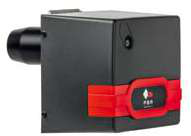
Single-stage burners like the FBR X G OSR 2003 TC R S are engineered specifically for low-emission heating applications. This model delivers 14.2–36.7 kW thermal output with NOx emissions consistently below 120 mg/kWh—a specification that meets Singapore's strictest environmental standards and positions facilities well for upcoming regional harmonization.
Key Technical Characteristics:
- Flame Geometry Control: Single-stage combustion uses fixed flame characteristics optimized for low-temperature combustion, reducing NOx formation at the molecular level.
- Operating Voltage: Runs on 1N~230V, simplifying electrical integration in facilities with standard single-phase distribution.
- Thermal Range Limitations: The 14.2–36.7 kW output range is ideal for small-to-medium heating loads but cannot scale to industrial production demands exceeding 40 kW.
- Fuel Efficiency: Achieves consistent fuel-to-energy conversion without requiring modulation, reducing control complexity and maintenance overhead.
Single-stage burners require fewer moving parts and control stages, translating to simpler troubleshooting and lower spare parts inventory. However, they lack modulation capability—if your facility experiences variable heating demand, a fixed-output burner will cycle on/off frequently, increasing wear and reducing component lifespan. Your maintenance team should expect more frequent on-off cycles and higher service call frequency during partial-load operations.
Multi-Stage High-Output Burners: Performance-Optimized Architecture
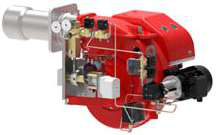
Multi-stage burners like the FBR FGP 130/M TC EVO SA and the FBR KN 550/M TL EL represent the opposite tradeoff. These systems prioritize thermal output and operational flexibility over emissions minimization.
The FBR FGP 130/M TC EVO SA delivers 1326 Mcal/h (approximately 1540 kW) using progressive two-stage combustion, allowing the burner to scale thermal output to match real-time facility demand. The FBR KN 550/M TL EL pushes this further—a dual-fuel heavy-oil burner rated at 698–6395 kW across 2 modulating stages, enabling precision heating control across a 10:1 turndown ratio.
Key Technical Characteristics:
- Progressive Two-Stage Combustion: Primary stage runs at reduced flame intensity during low-demand periods; secondary stage engages as heating demand increases. This architecture reduces cycling wear but does not achieve sub-120 mg/kWh NOx emissions.
- Modulation Capability: Both burners offer continuous load adjustment, eliminating the on-off cycling inefficiency of single-stage systems.
- Thermal Output Range: The FBR KN 550/M TL EL covers 698–6395 kW—spanning from small facility retrofits to large-scale district heating networks.
- Dual-Fuel Flexibility: The KN 550/M model operates on both heavy oil and gas, reducing fuel procurement constraints in regions where fuel availability fluctuates seasonally.
- Higher Electrical Requirements: Three-phase 400V power (3~400V) limits installation to facilities with industrial-grade electrical infrastructure.
Multi-stage modulating burners require more sophisticated control systems—your team must manage flame detection sensors, pressure switches, and modulation relays in addition to burner hardware. Troubleshooting becomes more complex because multiple failure modes exist across control stages. However, reduced on-off cycling dramatically extends component lifespan, and the ability to match load to demand improves overall thermal efficiency, offsetting higher maintenance complexity with lower long-term operational costs.
Emissions Compliance vs. Thermal Output: The Operational Tradeoff Matrix
The choice between low-emission single-stage burners and high-output multi-stage systems is not binary—it depends on your facility's specific regulatory environment and thermal requirements.
When Single-Stage Low-Emission Burners Make Economic Sense:
- Your facility is located in Singapore, urban Malaysia, or other regions with confirmed NOx regulations below 120 mg/kWh.
- Thermal demand is stable and predictable (e.g., building comfort heating, small industrial processes).
- Electrical infrastructure is single-phase 230V.
- Long-term compliance risk reduction justifies slightly higher operational cycling costs.
- Facility size makes multi-stage burner installation impractical.
- Facility operates in regions without enforced NOx limits or with phased compliance timelines.
- Thermal demand varies significantly throughout operational seasons (e.g., food processing, pharmaceutical manufacturing).
- Three-phase 400V power distribution is already installed.
- Fuel flexibility (dual-fuel capability) reduces procurement disruption risk.
- Thermal load exceeds 40 kW—single-stage burners cannot meet requirements.
- Expected facility operational life exceeds 15 years; reduced cycling wear justifies higher capital cost.
Practical Selection Framework for Southeast Asia Maintenance Teams
Your maintenance team should follow this structured approach when evaluating Burners & Combustion options:
Step 1: Verify Local Regulatory Requirements
Contact your regional environmental agency and facility's local government unit. Confirm whether NOx limits are mandatory now or expected within your facility's remaining asset lifespan (typically 10–20 years). Singapore's standards are well-defined; Malaysia and Indonesia have emerging frameworks—clarify your specific jurisdiction.
Step 2: Calculate True Thermal Demand
Collect 12 months of operational data. Plot hourly heating demand as a percentage of maximum capacity. If demand ranges between 50–100% of maximum, multi-stage modulation saves 15–20% in annual fuel costs compared to single-stage on-off cycling. If demand clusters above 80%, single-stage becomes viable.
Step 3: Assess Electrical Infrastructure
Confirm available power. Single-phase 230V installations can only support the FBR X G OSR 2003 TC R S (36.7 kW max). Multi-stage systems require three-phase infrastructure but offer 10–100x higher thermal output.
Step 4: Project Total Cost of Ownership
Compare:
- Capital Cost: Multi-stage burners cost 30–50% more upfront.
- Maintenance Labor: Single-stage requires more frequent service calls; multi-stage requires more sophisticated technician skills.
- Fuel Consumption: Multi-stage modulation typically saves 12–18% annually versus fixed-output cycling.
- Regulatory Risk: Low-emission burners eliminate future compliance costs.
For a typical Southeast Asia industrial facility with 15-year asset life, multi-stage modulating burners break even within 5–7 years through reduced fuel and maintenance costs.
Step 5: Future-Proof Your Specification
If regulatory trajectory is unclear, specify multi-stage burners with low-NOx combustion optimization. Modern systems like the FBR FGP 130/M TC EVO SA achieve near-120 mg/kWh emissions in Stage 1 (low-load operation) while maintaining full 1540 kW output in Stage 2. This architecture hedges against future emissions tightening while preserving maximum operational flexibility.
Implementation Guidance for 3G Electric Partners
3G Electric's 35+ years serving Southeast Asia's industrial equipment market has taught us that burner selection cannot be standardized. Your facility's unique combination of regulatory environment, thermal demand profile, and electrical infrastructure determines the optimal technology.
Our technical support team recommends reviewing existing burner logs and control system documentation before specifying replacement equipment. Many facilities retrofit lower-power burners than their systems can accommodate, creating artificial operational bottlenecks. Conversely, oversized burners in low-demand applications waste 20–30% of their capacity through cycling inefficiency.
When you're ready to evaluate specific models—whether the compliance-focused FBR X G OSR 2003 TC R S, the thermal-optimized FBR FGP 130/M TC EVO SA, or the heavy-duty dual-fuel FBR KN 550/M TL EL—our team can provide detailed performance data, local reference installations, and integration support.
The key to long-term maintenance success is matching burner technology to your facility's actual operational profile, not theoretical maximum capacity. Invest time in data collection now; it will guide equipment decisions that pay dividends across your facility's remaining service life.