Understanding Burners & Combustion Regulation Shifts in Southeast Asia
Southeast Asian industrial regulators are tightening emissions standards across Singapore, Thailand, Malaysia, and Vietnam. The region's shift toward stricter NOx limits (often below 120 mg/kWh in Singapore) requires procurement teams to rethink burner selection criteria. Traditional high-output burners that prioritize thermal capacity over emissions no longer fit modern compliance frameworks.
With over 35 years of experience distributing industrial equipment across Asia-Pacific, 3G Electric has observed this transition firsthand. Procurement engineers now face a critical question: should thermal output remain the primary specification driver, or must emissions performance become co-equal in equipment selection?
This comparison examines four burner architectures—single-stage low-emission, progressive two-stage, and dual-fuel modulating systems—to show how each balances regulatory compliance, thermal delivery, and lifecycle costs for Southeast Asian operations.
Single-Stage Low-Emission Burners: Compliance First, Modest Output
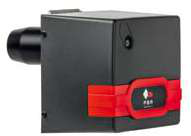
The FBR X G OSR 2003 TC R S represents the single-stage low-emission category. Designed for light-oil applications, this burner delivers 14.2–36.7 kW thermal output with NOx emissions below 120 mg/kWh—well within Singapore's current standards and compatible with anticipated tightening across Malaysia and Vietnam.
Key characteristics:
- Thermal output: 14.2–36.7 kW (modest for heavy industrial applications)
- Emissions: Below 120 mg/kWh NOx (compliant with Singapore standards)
- Fuel type: Light-oil diesel
- Power requirement: Single-phase 230V (flexible for distributed heating)
- Application fit: Smaller heating loads, district heating, facility-level heating systems
Operating cost reality: While initial purchasing cost is lower, operational efficiency is fixed across the thermal range. You cannot modulate to part-load conditions, meaning oversized systems waste fuel during off-peak seasons—common in Southeast Asia's variable industrial demand.
Progressive Two-Stage Combustion: Output and Compliance Balance
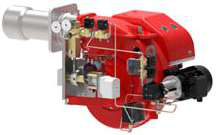
The FBR FGP 130/M TC EVO SA exemplifies progressive two-stage architecture. This light-oil diesel burner delivers 1,326 Mcal/h (approximately 1,540 kW) with progressive two-stage combustion, enabling efficiency gains impossible in single-stage units.
Key characteristics:
- Thermal output: 1,326 Mcal/h (1,540 kW nominal)
- Combustion strategy: Progressive two-stage (high-efficiency low-NOx)
- Fuel type: Light-oil diesel
- Modulation capability: Two-stage staging reduces part-load emissions
- Application fit: Medium to large industrial heating, combined heat and power, district heating hubs
Operational efficiency trade-off: Two-stage systems require more sophisticated control integration. You must budget for flame detection upgrades, modulation controls, and pilot burner commissioning. However, this investment pays dividends in fuel consumption reduction. Field data from 3G Electric's industrial customers across Southeast Asia show 8–12% fuel savings versus fixed single-stage burners over five-year operating cycles.
Hidden cost consideration: Maintenance teams need expanded skills. Troubleshooting two-stage combustion requires understanding flame patterns at both stages, which your technicians may lack initially. Factor in training costs and extended commissioning timelines.
Dual-Fuel Modulating Systems: Maximum Flexibility at Highest Complexity
The FBR KN 550/M TL EL represents heavy-oil dual-fuel architecture with full modulating capability. Delivering 698–6,395 kW across two modulating stages, this burner accommodates industrial facilities with volatile heating demand and fuel-switching requirements.
Key characteristics:
- Thermal output: 698–6,395 kW (nine-fold turndown ratio)
- Fuel type: Heavy oil and gas (dual-fuel with automatic switching)
- Modulation: Continuous modulating across full range (not stepped)
- Protection rating: IP40 (suitable for tropical Southeast Asian environments)
- Operating noise: 87–91 dBA (within industrial standards)
- Power requirement: Three-phase 400V (standard industrial supply)
Thermal efficiency potential: True modulation (not stepping) allows continuous tuning to instantaneous demand. In facilities with 30–60% average part-load operation, modulating burners reduce fuel consumption by 15–25% versus two-stage alternatives. Over a 10-year lifecycle, this translates to substantial cost recovery for the higher initial capital expenditure.
Complexity costs: Dual-fuel systems demand:
- Dual fuel supply infrastructure (oil tanks, gas lines, pressure regulation)
- More sophisticated control electronics and pressure switch integration
- Extended commissioning (fuel switching verification, valve sequencing)
- Higher spare parts inventory (dual-fuel solenoids, nozzles for both fuels)
- Specialized technician training (gas safety, oil atomization, switching logic)
For smaller facilities or those on single fuel supplies, this complexity is unjustifiable. For large industrial operations, the operational flexibility and efficiency gains offset added costs.
Comparative Procurement Decision Framework for Southeast Asia
Selecting the right burner technology requires matching system specifications to three operational variables unique to your region:
1. Regulatory Environment
- Singapore: Strict NOx limits (below 120 mg/kWh). Single-stage and progressive two-stage both viable; dual-fuel adds unnecessary complexity unless fuel switching is operational requirement.
- Thailand & Malaysia: Moderate regulations, trending stricter. Two-stage burners future-proof your investment without over-engineering.
- Vietnam & Cambodia: Developing standards with potential rapid tightening. Dual-fuel modulators offer longest compliance runway but highest initial cost.
- Constant load (refineries, continuous process heating): Dual-fuel modulators maximize efficiency across extended part-load operation.
- Variable seasonal load (food processing, textile facilities): Two-stage burners balance output availability with part-load efficiency.
- Distributed smaller loads (district heating, facility networks): Single-stage units reduce interconnection complexity despite inventory trade-offs.
- High capex flexibility, low fuel cost: Invest in modulating dual-fuel systems (typical for large industrial parks).
- Constrained upfront budget, high fuel costs: Two-stage progressive systems offer 80% of modulation benefits at 60% of dual-fuel cost.
- Minimal capex, uncertain demand: Single-stage low-emission burners minimize technical risk despite higher per-unit fuel consumption.
Integration and Procurement Logistics
Beyond thermal specifications, procurement engineers must evaluate supply chain factors specific to Southeast Asia's industrial ecosystem.
Lead times and inventory: Single-stage burners (like the FBR X G OSR 2003 TC R S) maintain shorter lead times from regional distribution centers. Dual-fuel modulating systems may require 8–12 week sourcing windows, affecting project timelines.
Technical support access: Ensure your distributor maintains commissioning expertise in your operational geography. 3G Electric's regional technical teams across Singapore, Bangkok, Kuala Lumpur, and Ho Chi Minh City provide on-site support for complex two-stage and dual-fuel installations—critical when your maintenance team lacks initial experience.
Spare parts localization: Verify that replacement nozzles, electrodes, and solenoid valves are stocked regionally. Lead times for components from Europe or North America can exceed 4 weeks, creating operational risk during furnace downtime.
Commissioning protocols: All three burner types require third-party flame detection verification in Singapore and increasingly in Thailand. Factor 2–4 weeks for regulatory sign-off and testing documentation—often overlooked in procurement timelines.
Procurement engineers should request detailed technical documentation and regional reference installations before finalizing specifications. Drawing on 3G Electric's distributor network, we can connect you with operational facilities running identical equipment in comparable climates, enabling confidence in specification decisions before capital commitment.