Pump Seal Degradation and Leakage: Troubleshooting Guide for Industrial Operations
Pump seal failure represents one of the most common and costly problems in industrial pump operations worldwide. Whether you're managing centrifugal pumps, positive displacement units, or high-pressure systems, seal degradation directly impacts system reliability, environmental compliance, and maintenance budgets. This troubleshooting guide equips maintenance teams and service engineers with practical diagnostic methods to identify seal wear patterns, understand failure mechanisms, and implement preventive strategies that extend pump life and reduce unplanned downtime across global industrial applications.
Understanding Pump Seal Degradation: Root Causes and Failure Mechanisms
Pump seals operate under extreme conditions—simultaneously managing pressure differentials, rotational speeds, fluid chemistry, and thermal stress. Unlike other pump components, seals experience continuous contact between stationary and rotating elements, making them inherently prone to wear.
Primary degradation mechanisms include:
Mechanical wear occurs when microscopic surface irregularities on seal faces accumulate friction damage. As rotating shafts spin at speeds between 1,450 and 3,600 rpm—typical for industrial Interpump units—seal face materials gradually thin. This is accelerated in high-pressure systems operating at 100–250 bar, where fluid films between seal components become increasingly difficult to maintain.
Thermal degradation happens when frictional heat from seal face contact exceeds the material's temperature tolerance. Elastomers like nitrile and EPDM rubbers soften when exposed to sustained temperatures above their rated limits, causing permanent dimensional loss and loss of sealing force. Tropical and high-ambient environments common in Southeast Asia exacerbate thermal stress.
Chemical attack occurs when pump fluids—oils, emulsions, or process liquids—chemically interact with seal materials. Certain synthetic fluids, biodiesel, and hydraulic additives can swell or harden elastomers unpredictably, compromising sealing geometry over weeks or months.
Cavitation-induced erosion happens when vapor bubbles form near the seal cavity due to pressure drops or starvation. Bubble collapse creates localized shock waves that pit and erode seal faces, especially on the suction side of pumps operating below 100 bar.
Understanding which mechanism is driving your seal failure is essential for selecting the right corrective action—replacing only the seal without addressing root cause typically results in repeat failure within weeks.
Diagnostic Procedures: How to Identify Seal Degradation Before Failure
Effective seal diagnostics combine visual inspection, performance monitoring, and fluid analysis. Early detection prevents catastrophic leakage that damages bearings and motor windings.
Visual inspection protocol: Stop the pump and inspect the seal area without forcing components apart. Look for:
- Weeping/seeping: Light fluid film around the shaft indicates early seal face separation. This is normal in new installations but should stabilize within 8–24 operating hours. Persistent weeping after break-in suggests face waviness or contamination particles.
- Steady streams: Active liquid flow from the seal cavity indicates substantial face wear or pressure imbalance. Measure the drip rate—more than 5–10 drops per minute typically requires seal replacement.
- Discoloration: Dark, carbonized residue around the seal gland indicates overheating. Compare the color to the fresh fluid—if noticeably darker or smells burnt, thermal degradation is occurring.
- Crystalline deposits: White or yellowish salt-like buildup suggests fluid decomposition or mineral precipitation, common in systems with water contamination or high operating temperatures.
Performance monitoring: Track these parameters over time using existing instrumentation:
- Pressure readings: Seals that are degrading often allow internal leakage, causing downstream pressure loss. If a pump maintains flow but exhibits 5–10% pressure drop relative to baseline, suspect seal bypass.
- Flow rate trends: Compare volumetric flow output against motor speed. Declining flow at constant rpm indicates internal leakage through the seal cavity.
- Temperature rise: Seals generate heat proportional to friction. Suction-side temperatures 10–15°C above inlet fluid temperature are normal; increases beyond 20°C suggest accelerated friction.
Fluid condition analysis: Send oil or fluid samples to a laboratory if seal degradation is suspected. Request analysis of:
- Ferrous particle count (indicates seal material erosion)
- Water content (promotes chemical attack on elastomers)
- Viscosity at operating temperature (reveals thermal breakdown)
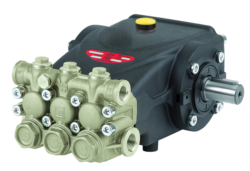
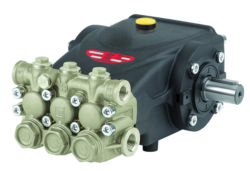
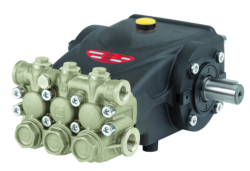
High-pressure systems like the Interpump E3B2515I operating at 250 bar are particularly sensitive to seal bypass—small pressure losses compound quickly in compact designs rated for 3,625 psi operation.
Common Seal Failure Patterns and Corrective Actions
Scenario 1: Early weeping (0–500 operating hours)
New seals often exhibit light leakage during run-in as seal faces lap together. This is normal. However, if weeping persists beyond one week of continuous operation, the issue is likely contamination.
Diagnosis: Fluid condition analysis will show elevated particle counts or water. The seal faces are damaged by abrasives before achieving full contact.
Corrective action: Replace the seal and flush the pump cavity with clean fluid. Install a suction-side strainer (100–150 micron) if not already present. For systems like the Interpump E3C1515L handling 150 bar flows, contamination prevention is critical because wear particles circulate through the system.
Scenario 2: Steady leakage with normal pressure (500–5,000 hours)
Gradual seal wear manifests as visible dripping with maintained system pressure. This indicates mechanical wear of seal faces without chemical or thermal degradation.
Diagnosis: Fluid analysis shows ferrous particles consistent with bronze or carbon erosion. Temperature is within normal range; pressure is stable. The seal has simply reached wear limits.
Corrective action: Schedule seal replacement at the next planned maintenance window. No emergency shutdown is required unless drip rate exceeds 20 drops per minute, which risks oil starvation to adjacent bearings. Use this opportunity to upgrade to a harder seal face material (e.g., tungsten carbide) if the application experiences frequent re-sealing.
Scenario 3: Thermal degradation with rising temperature
Seal cavity temperature exceeds baseline by 25°C or more. Fluid condition shows viscosity breakdown. Leakage increases progressively over days or weeks.
Diagnosis: Friction at the seal interface has exceeded cooling capacity. Common causes include:
- Excessive pump speed (above rated rpm)
- Restricted cooling circulation (clogged seal flush lines)
- Incompatible fluid viscosity (too thick for the seal type)
- Bearing preload too tight
Corrective action: First, verify pump speed is within nameplate limits. For high-speed applications like the Interpump E3B2515L at 1,450 rpm, confirm coupling alignment—misalignment increases seal friction. Check seal flush line patency; if clogged, clean or replace. If thermal stress is recurring, specify a seal design rated for higher temperature (typically elastomer upgrades from nitrile to EPDM or FKM).
Scenario 4: Sudden gushing with pressure loss
Abrupt high-volume leakage with 10–20% system pressure drop indicates seal face fracture or complete separation.
Diagnosis: This is an emergency condition requiring immediate shutdown. Do not attempt to monitor further.
Corrective action: Stop the pump immediately to prevent oil loss and bearing damage. Inspect the seal cavity for foreign object damage (debris, misaligned installation, or mechanical collision). Replace the seal assembly completely. If fractures recur, investigate pump vibration (bearing wear, cavitation, misalignment) as the underlying cause.
Best Practices for Seal Selection and Preventive Maintenance
Match seal type to application duty: Industrial pumps operate across diverse fluid types and pressure ranges. Low-pressure applications like the Interpump E3C1021 at 100 bar tolerate simpler mechanical seals with nitrile elastomers. High-pressure systems at 250 bar require dual-seal designs with tungsten carbide or ceramic faces to withstand pressure spikes and thermal stress.
Implement condition-based replacement: Rather than replacing seals on a fixed interval, use visual inspection and performance trending to detect degradation early. This reduces cost and downtime compared to calendar-based replacement in low-wear scenarios, while preventing failures in high-stress applications.
Maintain fluid cleanliness: The single most effective seal preservation practice is preventing contamination. Install intake strainers rated 100–150 micron and change them at half the pump manufacturer's recommended interval. Use sealed reservoir covers and check breathers monthly.
Document baseline conditions: Record initial pressure, flow, temperature, and visual observations when the pump is new or freshly serviced. Use this as a reference for detecting degradation trends. Temperature increases of 15–20°C over 1,000 hours of operation are red flags warranting investigation.
Train maintenance staff: Seal inspection is a learned skill. Ensure your team understands the difference between normal run-in weeping and problem weeping, and knows when to call for specialist support.
When to Seek Professional Support
If seal leakage recurs within 500 operating hours of replacement, the root cause is likely not the seal itself but rather environmental factors (contamination, thermal stress, misalignment) or pump design mismatch. Contact your equipment distributor or pump manufacturer for diagnostics. 3G Electric maintains technical partnerships with leading industrial pump manufacturers and can help troubleshoot complex seal failures, recommend upgraded seal designs, and supply replacement assemblies suited to your specific system parameters.
Pump seal degradation is preventable with disciplined inspection, fluid management, and timely intervention. By implementing these troubleshooting practices, maintenance teams can extend seal life from typical 2–3 year intervals to 4–5 years or longer, significantly reducing operational costs and improving system reliability across global industrial applications.
Have questions about seal selection, diagnostics, or replacement procedures for your specific pump model? Browse our full range of industrial pumps and sealing components, or contact the 3G Electric technical team today for expert guidance tailored to your operation.