Understanding Gas Valves & Regulation in System Architecture
Gas Valves & Regulation components function as critical control points within larger industrial systems, yet procurement decisions often treat them as standalone purchases. Unlike simple specification matching, system integration requires understanding how pressure regulation, flow control, and safety interlocks interact across your operational environment. With 35+ years of experience as an global industrial equipment distributor, 3G Electric has observed that procurement engineers increasingly face pressure to reduce system downtime while managing budget constraints—creating a complex calculus that demands deeper technical visibility.
The fundamental challenge lies in recognizing that gas regulation failures rarely stem from component defects alone. Instead, they typically emerge from integration points where system pressure profiles, upstream equipment characteristics, downstream load variations, and environmental conditions converge. A pressure regulator specified correctly for nominal operating conditions may exhibit poor response characteristics during transient states—startup sequences, emergency shutdown events, or load shedding scenarios—that weren't adequately modeled during the procurement phase.
Effective procurement strategy requires evaluating regulation systems across three integrated dimensions: pressure stability (maintaining setpoint within acceptable bandwidth), response dynamics (how quickly the regulator responds to upstream or downstream disturbances), and turndown ratio (the range between minimum and maximum controllable flow). Each dimension carries different implications for downstream equipment protection, energy efficiency, and maintenance frequency.
Pressure Profile Mapping & Regulator Sizing Strategy
Before selecting specific regulators, procurement engineers must establish accurate pressure profile maps across the entire gas distribution network. This involves documenting nominal operating pressures, expected transient events, seasonal variations, and emergency scenarios. Many organizations discover during commissioning that their pressure requirements weren't accurately characterized—leading to regulators operating outside optimal performance bands or requiring expensive field modifications.
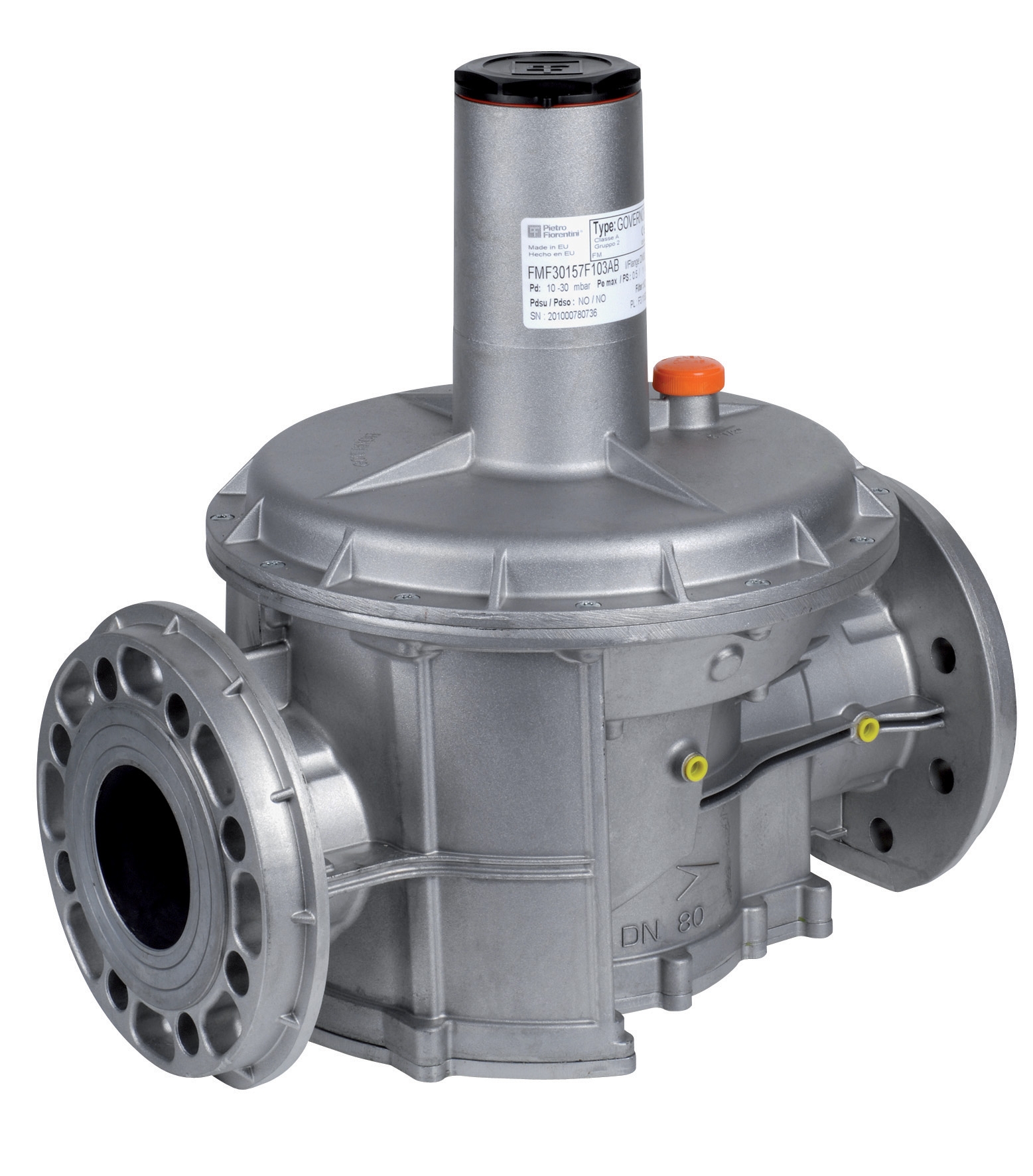
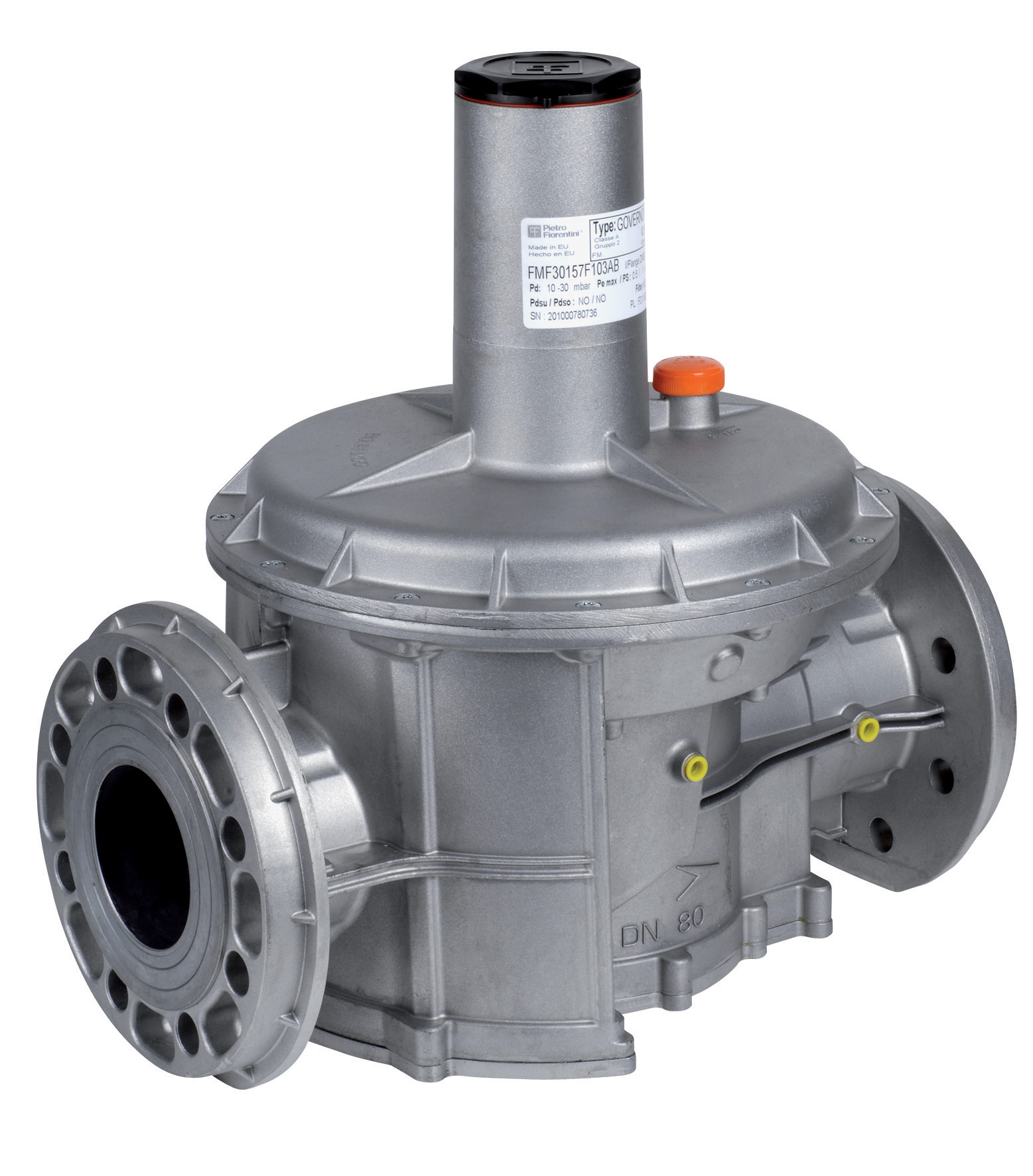
The CBM FAG product family offers flexible options for different system architectures. For compact installation spaces or systems with moderate flow requirements, the threaded 1"1/2 pressure regulator (500 Mbar inlet, 5-300 Mbar outlet setpoint) provides threaded connections suitable for retrofit applications and systems where flanged connections would create installation complications. This configuration handles approximately 60-80 Nm³/h gas flow, making it appropriate for distributed control points rather than primary regulation stations.
Larger capacity systems require flanged connections that eliminate threaded fitting leak points and support higher flow velocities. The DN65 flanged regulator accommodates approximately 400-500 Nm³/h, serving as appropriate primary regulation equipment for industrial networks. The DN40 flanged option bridges intermediate applications at roughly 150-200 Nm³/h capacity. These specifications become critical inputs for network pressure drop calculations—a 0.5 bar pressure drop across the regulator represents inefficiency that compounds across multiple regulation stages.
Procurement engineers should develop sizing worksheets that account for:
- Nameplate flow rating under nominal conditions (typically at 80% of maximum to preserve control margin)
- Transient flow demands (startup sequences, emergency loads) that may exceed nominal by 30-50%
- Downstream pressure variation across the distribution network (elevation changes, pipe lengths)
- Turndown requirements (minimum controllable flow relative to maximum rated flow)
- Hysteresis characteristics (pressure band width where regulator maintains setpoint stability)
Understanding these parameters prevents specifying regulators that operate at continuous maximum or minimum rated flow—both conditions reduce regulator lifespan and increase maintenance frequency. Optimal control occurs when regulators operate near 50-70% of rated capacity, where diaphragm movement remains linear and control stability is maximized.
Integrated Filtration & Contamination Control in Regulation Systems
Gas regulation systems tolerate significantly less contamination than many procurement engineers assume. Particulate matter, liquid carryover, and corrosion deposits accumulate on regulator diaphragms and seating surfaces, causing creep (unwanted pressure drift), chatter (oscillation around setpoint), and ultimately seal failure. Traditional maintenance approaches address these failures reactively; strategic procurement integrates contamination control into the system design.
The CBM FAG combined regulator-filter units address this integration requirement. The DN100 regulator with integrated filter (500 Mbar inlet, 5-300 Mbar outlet) consolidates three traditionally separate components—inlet strainer, water separator, and pressure regulator—into a single manifold. This integration delivers multiple procurement advantages:
Reduced installation complexity: Combined units eliminate multiple connection points where leakage occurs, require less manifold space, and reduce assembly labor costs by approximately 20-30% compared to three-component installations.
Improved maintenance economics: Integrated filter elements service alongside regulator maintenance, ensuring synchronous component replacement and eliminating scenarios where regulators receive contaminated gas between filter service intervals.
Performance stability: Filter elements located immediately upstream of the regulator prevent particulate migration into diaphragm cavities, maintaining control linearity and extending regulator service life by 50-70% compared to systems with remotely located filters.
For space-constrained applications, the compact threaded regulator-filter (DN 3/4" connections, 500 Mbar inlet, 5-150 Mbar outlet) provides equivalent integrated protection in footprints suitable for distributed control points. This configuration addresses the common procurement challenge where distributed regulation nodes throughout the network previously lacked filtration, forcing all contamination control to the primary station.
Procurement specifications should mandate integrated or closely coupled filtration based on calculated gas contamination loads. This calculation incorporates upstream equipment (compressors, dryers, storage vessels) filtration standards, distribution line material and age, and the contamination sensitivity of downstream equipment. Natural gas systems typically tolerate higher particulate loads than technical gases, but integrated filtration remains valuable for extending regulator service life even in less demanding applications.
Risk Assessment Frameworks & Supplier Qualification
Procurement engineers evaluating gas regulation suppliers must extend beyond ISO 9001 certifications and standard pressure testing protocols. Strategic supplier qualification requires examining how manufacturers characterize control performance, validate designs across full operating envelopes, and support field troubleshooting when system behavior diverges from expectations.
Performance characterization under real conditions: Request flow-pressure response curves (not just static pressure settings) across the manufacturer's stated operating envelope. Curves should document control stability (setpoint drift over time), response time (seconds to achieve setpoint after inlet pressure disturbance), and hysteresis bandwidth (pressure variation between opening and closing). Many manufacturers publish only nominal conditions; realistic procurement requires worst-case scenarios (minimum inlet pressure, maximum flow demand, ambient temperature extremes).
Verification of materials compatibility: Beyond standard pressure vessel certifications, verify material selections for your specific gas composition. Hydrogen applications, for instance, require different elastomer selections than natural gas due to permeation and embrittlement risks. CBM FAG regulators used throughout 3G Electric's distribution network support diverse applications—verify that your selected configuration carries material certifications appropriate for your gas type and purity requirements.
Field troubleshooting support and spare parts availability: Regulation system failures often occur in ways that don't match textbook descriptions. Suppliers should provide technical teams capable of diagnosing field failures through telephone consultation, recommend field repairs versus component replacement based on diagnostic data, and maintain spare parts availability aligned with your procurement organization's forward planning (typically 6-12 months of anticipated demand). 3G Electric's 35+ years as an distributor ensures spare parts availability and technical support continuity—a consideration that becomes critical when equipment failures occur in facilities remote from major industrial centers.
Documentation and traceability standards: Require manufacturers to provide detailed valve history documentation including manufacturing date, material certifications, pressure testing results, and calibration records. This traceability becomes essential if field failures occur and failure investigation requires understanding the specific unit's manufacturing conditions.
Lifecycle Cost Modeling & Total Cost of Ownership
Capital cost comparison remains the easiest procurement metric but the least predictive of actual total cost of ownership (TCO). Gas regulation system TCO accumulates across three distinct phases: acquisition (equipment cost, delivery, installation), operation (energy losses, maintenance labor, spare parts), and disposal (environmental compliance, recertification for secondary markets).
Acquisition phase costs include equipment price, connection hardware and manifold integration, installation labor, and commissioning pressure testing. Integrated regulator-filter units like the FAG15018 show higher equipment cost than separate components (typically 15-25% premium) but reduce total acquisition cost by 8-12% when installation labor, connection hardware, and manifold engineering are included.
Operational phase costs represent 60-70% of total seven-year TCO for most industrial gas systems. These costs include pressure differential losses (regulators dissipate energy when throttling upstream pressure to lower downstream setpoints), maintenance labor for filter element changes and regulator calibration checks, spare parts replacement when seals degrade, and production losses during regulation-related downtime events.
Calculating differential losses requires understanding your duty cycle. If your system operates with 100 bar inlet pressure reduced to 20 bar outlet pressure across a regulator handling 300 Nm³/h, the pressure differential energy loss equals approximately 80 bar × 300 Nm³/h = 24,000 bar·Nm³/h. At typical industrial electricity rates (€0.12/kWh), this translates to roughly €400-600 monthly energy loss from a single regulator. Over a seven-year system lifecycle, pressure differential losses can exceed equipment cost by 400-600%, making regulator selection a significant operational efficiency factor rather than a simple capital purchase.
Maintenance cost modeling should incorporate realistic failure mode assumptions. Regulator seal degradation increases proportionally with pressure cycling frequency and contamination exposure. Systems with integrated filtration (FAG15018, FAG14004) experience seal degradation rates 40-50% lower than systems with remote filtration, reducing maintenance labor costs and spare parts consumption. Model maintenance frequency assuming progressive seal deterioration—most regulatory agencies allow increasing leak rates within defined bands before mandatory replacement, not immediate replacement at first detectable leakage.
Disposal phase costs often remain invisible until equipment reaches end-of-life, but they influence procurement decisions more than many engineers recognize. Pressure vessels containing residual gas require certified disposal, with certification costs varying significantly by equipment size, material, and gas residue type. Modular systems like integrated regulator-filter units often face higher disposal costs than equivalent separated components due to hazardous waste classification complexity. Specify disposal responsibility in supplier contracts to avoid unexpected end-of-life costs.
Implementation Strategy for Procurement Teams
Transitioning from component-level to system-level procurement requires organizational change beyond technical specification development. Procurement teams should:
Establish cross-functional specification committees incorporating operations, maintenance, engineering, and procurement perspectives. Operations teams understand real-world pressure profiles and transient behaviors that engineers may not have modeled. Maintenance teams recognize failure patterns that guide realistic spare parts planning and maintenance labor estimates.
Develop pressure profile documentation standards capturing nominal, minimum, maximum, and transient operating conditions across your entire gas distribution network. This documentation becomes the foundation for rational regulator selection and serves as critical reference data when field troubleshooting occurs.
Create supplier evaluation matrices extending beyond price comparison to include technical support availability, spare parts lead times, field troubleshooting responsiveness, and material certification completeness. 3G Electric's quarter-century of distribution experience provides procurement visibility into supplier reliability—established relationships with CBM FAG and similar manufacturers ensure consistent spare parts availability and technical support that newer suppliers cannot guarantee.
Implement lifecycle cost analysis protocols requiring financial teams to evaluate operational and disposal costs alongside capital equipment costs. Present TCO analysis to financial decision-makers, not just equipment costs, to secure funding for higher-reliability systems that reduce long-term operational expenses.
Schedule supplier technical reviews at least annually, bringing manufacturer representatives into your facilities to understand your specific operational conditions, discuss emerging technologies or process improvements, and strengthen relationships that support troubleshooting when issues arise.
Gas Valves & Regulation system procurement demands strategic integration thinking—moving beyond component selection toward system design that balances capital cost, operational efficiency, reliability, and lifecycle management. Organizations that transition to this integration mindset reduce unplanned downtime, optimize energy efficiency, and make more rational capital allocation decisions across their industrial asset portfolio.